Compare and report
Compare checkpoints fairly
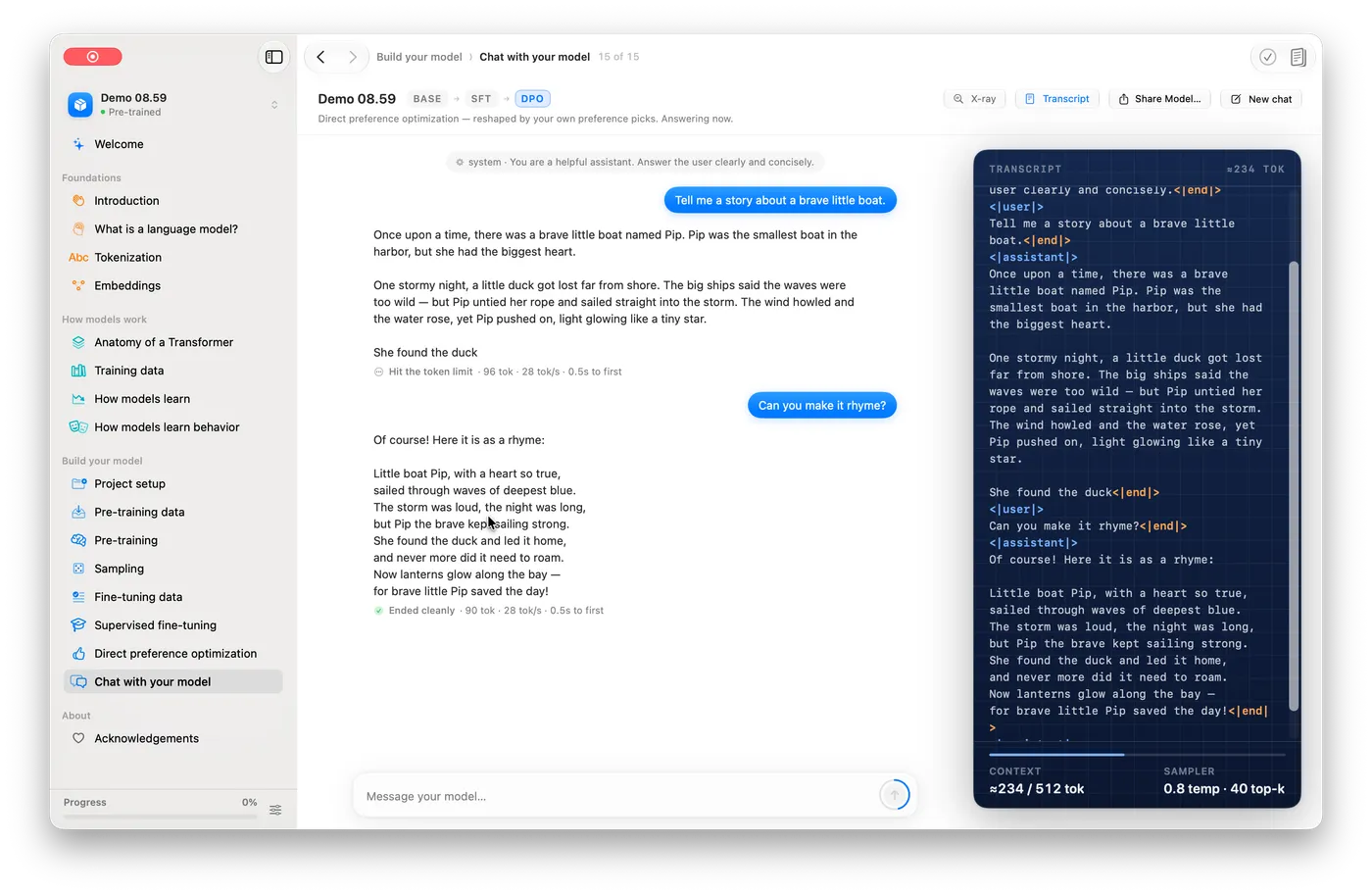
Build one comparison table that holds prompts and sampling settings constant across base, pre-trained, SFT, and DPO checkpoints.
Create a table in your notebook with one row per prompt and one column per checkpoint.
Use the same baseline prompts, generation length, temperature, top-k, top-p, min-p, and seed where available.
Compare model stages separately:
random initialization → pre-trained checkpoints
best pre-trained checkpoint → SFT checkpoint
SFT checkpoint → DPO checkpoint
Each transition answers a different question. Combining them into “the final model is better” hides which training stage changed the behavior.
Score only things you can explain. Useful columns include complete sentence, repetition, follows requested format, stays on topic, and unsupported claims.
Define the rubric before reading final samples. For a binary item such as “follows requested JSON format,” write the exact passing condition.
Use several fixed seeds when sampling is stochastic. Report a count such as 4 of 5 outputs completed the sentence, not only the best example.
Keep the raw samples under the table. A short score without its output is hard to audit.
Add loss and compute context beside behavioral results:
| Checkpoint | Training step | Validation loss | Training time | Notes |
|---|---|---|---|---|
| Early | ||||
| Best validation | ||||
| Final |
Check evaluation prompts against the training data when possible. A copied answer is evidence of memorization, not held-out generalization.
Choose the checkpoint you would keep and write one evidence-based reason. The latest checkpoint does not have to be the best one.
If two checkpoints are close, say the experiment cannot distinguish them. Honest uncertainty is more useful than choosing a winner from noise.
Fill the table before you pick a favorite checkpoint. I have watched people defend the final weights, then discover the middle checkpoint scored higher on every rubric row.
If DPO wins on instruction prompts but loses on story continuation, say that clearly. A fair comparison admits tradeoffs instead of crowning one winner.
Try this: score one prompt across base, best pre-trained, SFT, and DPO with the same seed. Paste all four outputs under the table row before you assign numbers.
Lesson completed