Gemini 4 Neon: I tested it against Opus 5.5
By Flavio
Tagged: AI
Gemini 4 Neon is the middle model of the Gemini 4 family. I ran it on two coding tasks, a writing task and a 100k-token search against Opus 5.5 and Gemini 4 Carbon, with real costs.
Google released Gemini 4 Neon on November 18, 2026. It’s the middle model of the Gemini 4 family: Carbon is the big one for long, hard projects, Hydrogen is the fast and cheap one, and Neon sits between them.
This is a good model. It got every one of my tests right, it writes well, and on long inputs it costs a lot less than Opus 5.5. On short tasks it thinks a lot, and that changes the math.
Here’s what I ran and what I found.
What Google shipped
The announcement positions Neon for software engineering, knowledge work and science. It has a 1 million token context window and four thinking levels. The default is high and the top one is xhigh.
You can use it in the Gemini app (Pro and Ultra plans), in Google AI Studio and the Gemini API with the model ID gemini-4-neon, in Google Antigravity and in Gemini Enterprise. I used it through OpenRouter, where it’s google/gemini-4-neon:
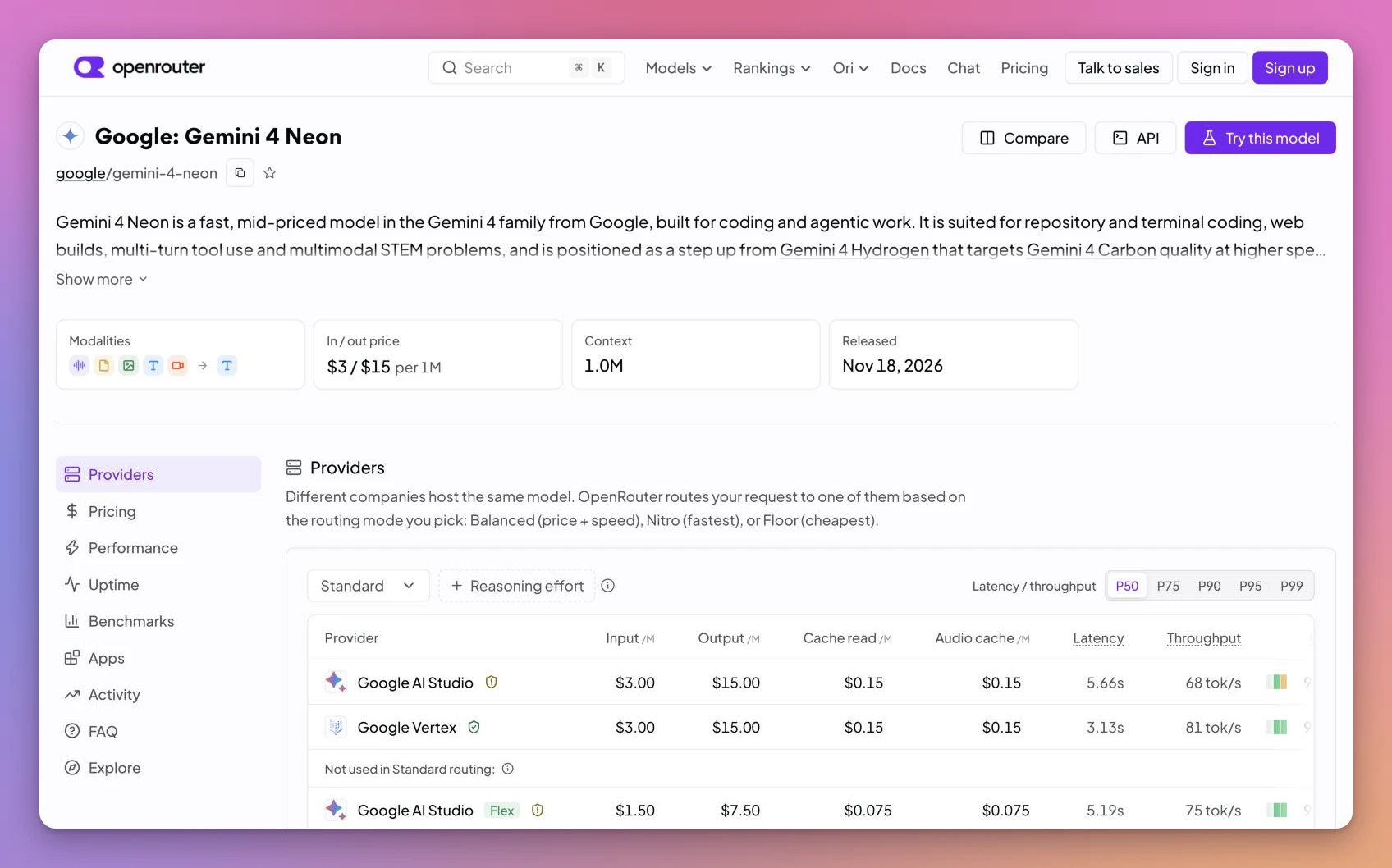
This is how the price compares with the models I tested it against, in dollars per million tokens on OpenRouter:
| Model | Input | Output | Context |
|---|---|---|---|
| Gemini 4 Neon | $3 | $15 | 1M |
| Gemini 4 Carbon | $2 | $10 | 1M |
| Claude Opus 5.5 | $4 | $20 | 1M |
Cached input on Neon is $0.15, a 95% discount. And yes, Carbon is cheaper per token than Neon. You’ll see below why it still costs more per task.
Google’s own numbers put Neon at #1 on the Artificial Analysis Coding Agent Index (58.6), 65.2% on Terminal-Bench 4.1, #2 on the Vals Index (70.9%) and #3 overall on the Artificial Analysis Intelligence Index. These are vendor-reported, so I wanted my own.
The test setup
I wrote a tiny Node script that sends one prompt to OpenRouter and prints the time, the tokens and the cost:
const [model, promptFile, effort] = process.argv.slice(2)
const prompt = readFileSync(promptFile, 'utf8')

const res = await fetch('https://openrouter.ai/api/v1/chat/completions', {
  method: 'POST',
  headers: {
    Authorization: `Bearer ${process.env.OPENROUTER_API_KEY}`,
    'Content-Type': 'application/json'
  },
  body: JSON.stringify({
    model,
    messages: [{ role: 'user', content: prompt }],
    reasoning: { effort },
    usage: { include: true }
  })
})
Then I ran the same prompts on google/gemini-4-neon, google/gemini-4-carbon and anthropic/claude-opus-5.5, all at high effort:
node run.mjs google/gemini-4-neon prompt-csv.txt highEvery coding answer went through a test file I wrote before running anything, so “correct” means it passed every case, not that it looked right.
Two coding tasks
The first one asks for a parseDuration() function: '1h30m' is 5400, '2h5s' is 7205, and it throws a RangeError for things like '30m1h', '1.5h' and '1h 30m'. I checked 30 inputs.
The second one is harder. A parseCSV() function with the annoying parts of CSV: quoted fields, "" as an escaped quote, line breaks inside quotes, \r\n vs a lone \r, a trailing newline that must not add a row, and a SyntaxError for a stray quote. I checked 27 inputs.
| Task | Model | Passed | Time | Output tokens | Cost |
|---|---|---|---|---|---|
parseDuration | Gemini 4 Neon | 30/30 | 12.7s | 1,275 | $0.020 |
parseDuration | Gemini 4 Carbon | 30/30 | 78.0s | 4,920 | $0.050 |
parseDuration | Claude Opus 5.5 | 30/30 | 6.8s | 571 | $0.012 |
parseCSV | Gemini 4 Neon | 27/27 | 49.3s | 6,032 | $0.091 |
parseCSV | Gemini 4 Carbon | 27/27 | 308.5s | 19,702 | $0.198 |
parseCSV | Claude Opus 5.5 | 27/27 | 12.4s | 1,392 | $0.029 |
All three got everything right. On parseDuration they even wrote the same regex, /^(?:([0-9]+)h)?(?:([0-9]+)m)?(?:([0-9]+)s)?$/.
The difference is in the thinking. On the CSV task Neon spent 5,495 tokens reasoning before writing about 70 lines of code, and Opus spent 694. So Neon is cheaper per token and still about 3x more expensive per task here.
Carbon is in another league of slow. Five minutes and almost 20,000 tokens for a CSV parser. The Hacker News thread says the same thing about Carbon, and it’s why Neon is the one I’d pick from the Gemini 4 family for everyday coding.
Neon is fast when it writes. It produced 6,032 tokens in 49 seconds, about 122 tokens per second, while Carbon did about 64.
Lower thinking levels
Since Neon overthinks a small task, I ran the CSV prompt again at low and medium:
| Effort | Neon | Neon cost | Opus 5.5 | Opus 5.5 cost |
|---|---|---|---|---|
low | 27/27, 24.5s | $0.040 | 27/27, 6.2s | $0.016 |
medium | 27/27, 39.1s | $0.065 | 27/27, 9.4s | $0.021 |
high | 27/27, 49.3s | $0.091 | 27/27, 12.4s | $0.029 |
Neon at low is still correct and costs less than half of high. My advice is to start there for small, well-specified functions, and leave high for the default it is in agents, where the extra thinking has more to work on.
A writing task
Many people in the HN thread said Gemini 4 writes better English than Claude. I gave all three a messy commit message to rewrite:
fixed the thing where the newsletter form was sending twice, it was because the submit handler got attached on every astro page transition so after navigating 3 pages you got 3 emails lol. now we check a data attribute before attaching. also removed console.logNeon:
fix: prevent duplicate newsletter form submissions

Astro page transitions were re-attaching the submit handler on each navigation, triggering multiple emails per submission. Guard listener attachment with a data attribute so it only binds once, and remove a leftover `console.log`.
Opus 5.5:
Fix duplicate newsletter form submissions

The submit handler was re-attached on every Astro page transition, so each navigation added another listener (3 pages = 3 emails). Now we check a data attribute before attaching.

Also remove stray console.log.
Both are good. Neon’s reads more like a real commit in a real repo, with the fix: prefix and one tight paragraph. Opus kept the “3 pages = 3 emails” detail, which is the fastest way to understand the bug. Carbon turned it into two short bullet points.
A 100k-token search
Neon’s lower input price should matter most when the prompt is big. So I took the 23 posts I published on this site between November 10 and 18, put them in one prompt, and asked for the slugs of every post that mentions OpenRouter. grep says the answer is openrouter-models and small-ai-models.
| Model | Answer | Input tokens | Time | Cost |
|---|---|---|---|---|
| Gemini 4 Neon | Both, nothing else | 103,361 | 13.9s | $0.33 |
| Claude Opus 5.5 | Both, nothing else | 139,963 | 6.3s | $0.57 |
Same prompt, same 385 KB of Markdown, and Gemini’s tokenizer counted 26% fewer tokens than Claude’s. Combine that with the lower price per token and Neon cost 42% less for the same correct answer.
That’s where I see Neon fitting: reading a lot and answering a little. A codebase, a pile of PDFs, a long log, a year of notes.
What people say on Hacker News
The HN thread reached 728 points and over 600 comments in its first day. The main points:
- Most people put Neon roughly in the same class as Opus 5.5, with Opus still preferred by many for coding.
- Several people praise Gemini 4’s writing, and some use it only to rewrite their commit messages.
- One commenter measured about 127 tokens per second for Neon on OpenRouter against about 46 for Carbon, close to what I saw.
- Others still don’t trust Gemini models with tool use, after problems with earlier versions.
- Nobody likes the names.
Should you use it
I’d use Neon for long-context jobs, where it was right and much cheaper than Opus 5.5, and for writing, where I liked its output. For short coding tasks it’s as correct as Opus but slower and more expensive per task at the default high effort, so drop it to low there.
I haven’t run it as an agent on a real project yet, and that’s where Google claims its biggest wins (lower cost per task than competing models on long agentic benchmarks). That’s the next test.
Want me to talk about your product? You can sponsor this site.
Related posts about ai: