
An app by Flavio
Calendar Batch Rescheduler
Move a group of Calendar events forward or back by a number of days or working days, skipping weekends and the days you mark as off, with a preview of every new date, clash warnings and an undo for the whole batch.
Buy Calendar Batch Rescheduler · $19One-time purchase. Plus tax where it applies.
macOS 14 or later · Apple silicon and Intel
Latest version 1.0.1, released November 22, 2026
Your biology course starts a week late. Every lecture, lab and office hour from week 3 on has to move seven days later. Except the ones that now land on the December 8 holiday, or in the middle of the winter break, which have to move on to the next school day.
In Calendar on the Mac you move events one at a time. Drag one, open the next, change the date, and for each date of the weekly office hours Calendar asks whether you mean this event or all future ones. Seventeen events later you’re still not sure you didn’t put two lectures on the same morning.
Calendar Batch Rescheduler moves the whole group at once. Tick the calendar, type part of the title, say how many days or working days, mark the days off, and click Find Events. You see every event’s old date and new date side by side, with the clashes in amber, before anything changes. Then Move 17 Events, and if something looks wrong, Undo This Batch puts them all back, today or next week.
Who it’s for
- Teachers whose course starts late. Every lecture and lab from week 3 on moves 7 days later. The holiday on December 8 and the winter break are skipped, and the clash with the staff meeting shows up before anything moves.
- Trainers running a workshop series when a strike day cancels a session. Every session from that day moves 1 working day later, with Saturday and Sunday off, or Friday and Saturday if that’s your weekend.
- Swimming and football coaches. The pool closes for two weeks, so the season’s practice sessions shift by 14 days. They keep their times, and you see which ones now land on another team’s slot.
- Project managers whose kickoff slips. Every milestone and review in the project calendar moves 3 working days later, skipping public holidays. If the client confirms the original date after all, undo the batch.
- University tutors who need a block of office hours a week earlier. Only those dates of the repeating event move. The rest of the series stays as it is.
From a slipped schedule to new dates
- Allow Calendar access. The first time, click Allow Calendar Access and choose Allow Full Access when macOS asks. The app needs it to read and change events. If access is off, or set to Add Events Only, the button becomes Open Privacy Settings.
- Tick the calendars. The sidebar lists your calendars grouped by account, with their colors. Read-only calendars, like a subscribed holidays calendar, have a lock and can’t be ticked.
- Pick the events. Set From and To: the app takes the events that start between those days, both included. Type part of the title in Title contains, like
Biology, or leave it empty to take every event in the range. Capitals and accents don’t matter. - Say how far they move. Type a number or use the stepper, pick days or working days, and Later or Earlier. With days, the checkbox If an event lands on a day off, move it on to the next working day is on to start with. With working days, only working days are counted.
- Mark the days off. Saturday and Sunday are highlighted to start with. Click the weekdays to change them. Add holidays with the two date fields and Add Days Off, or type them in the field below, like
2026-12-08, 2026-12-21..2027-01-06, and click Add. - Click Find Events (Command-R). If it can’t run yet, a “Next:” line under the button says what’s missing.
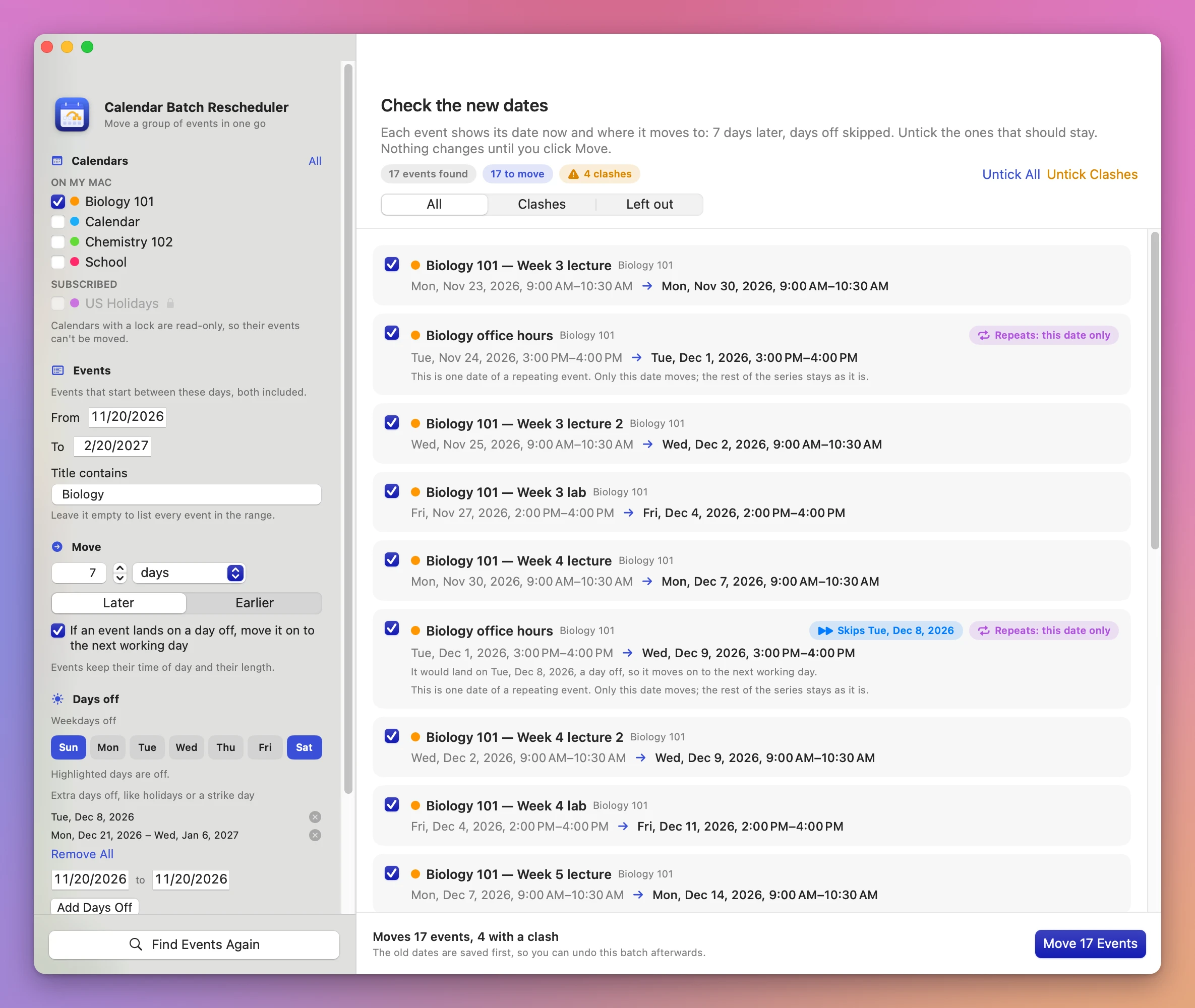
- Check the new dates. Every event shows its old date, an arrow and its new date. Untick the ones that should stay, or click Untick Clashes. Change anything in the sidebar and the list updates right away.
- Click Move 17 Events and confirm. The confirmation tells you how many events land on a time that’s already taken.
What you get
A preview of every new date
Nothing changes in Calendar until you click Move. Each row has the event’s title and calendar, the date it has now and the date it gets. Pills say why a date is what it is:
- Skips and a date, when the event would land on a day off and moves on to the next working day, with a line saying which day it skipped.
- Repeats: this date only, for a date of a repeating event.
- All day, for all-day events. A three-day field trip stays three days long.
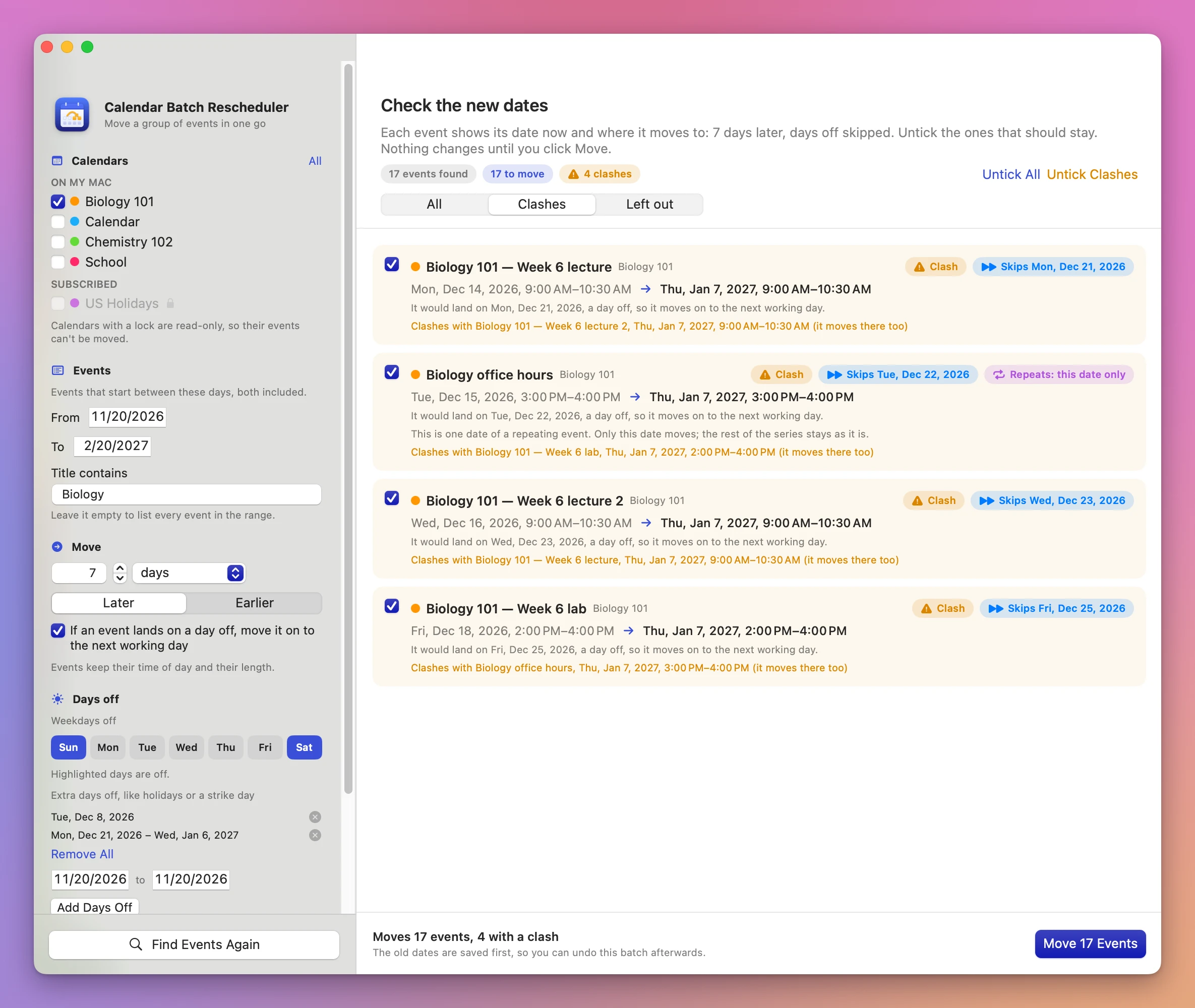
- Clash, in amber, with the title and time of the event it lands on, and “(it moves there too)” when that event is part of the same batch.
The pills at the top count the events found, the ones to move, the clashes and the ones that can’t move. All, Clashes and Left out filter the list.
Clash warnings that follow your choices
A clash is a moved event landing on the time of another event in the ticked calendars. When you untick an event, it stays where it is, so another event may now land on it. The app checks the clashes again every time you tick or untick.
All-day events only clash with other all-day events, unless you turn on Count all-day events as clashes.
Weekends and holidays skipped
Pick any weekdays as your weekend: Saturday and Sunday, Friday and Saturday, or just Sunday. Add single days off, like a strike day, and ranges, like a winter break. Moving by working days counts only the days that aren’t off. Moving by days adds the days, then pushes an event that lands on a day off to the next working day.
Events keep their time of day and their length, also across a change to or from summer time.
An undo for the whole batch
Before the app touches Calendar, it saves the batch to a file: every event, its old date and its new one. If that file can’t be saved, nothing moves.
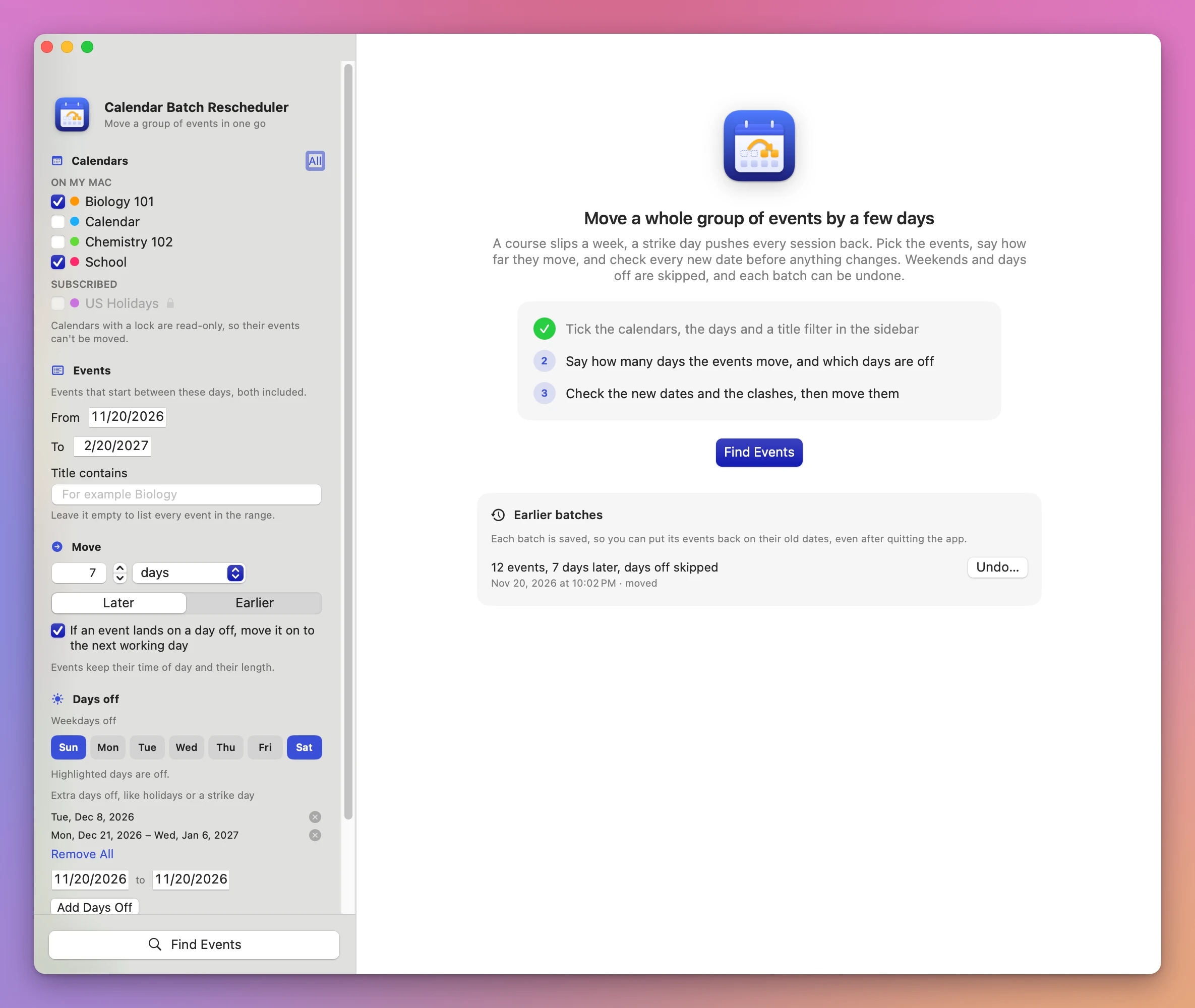
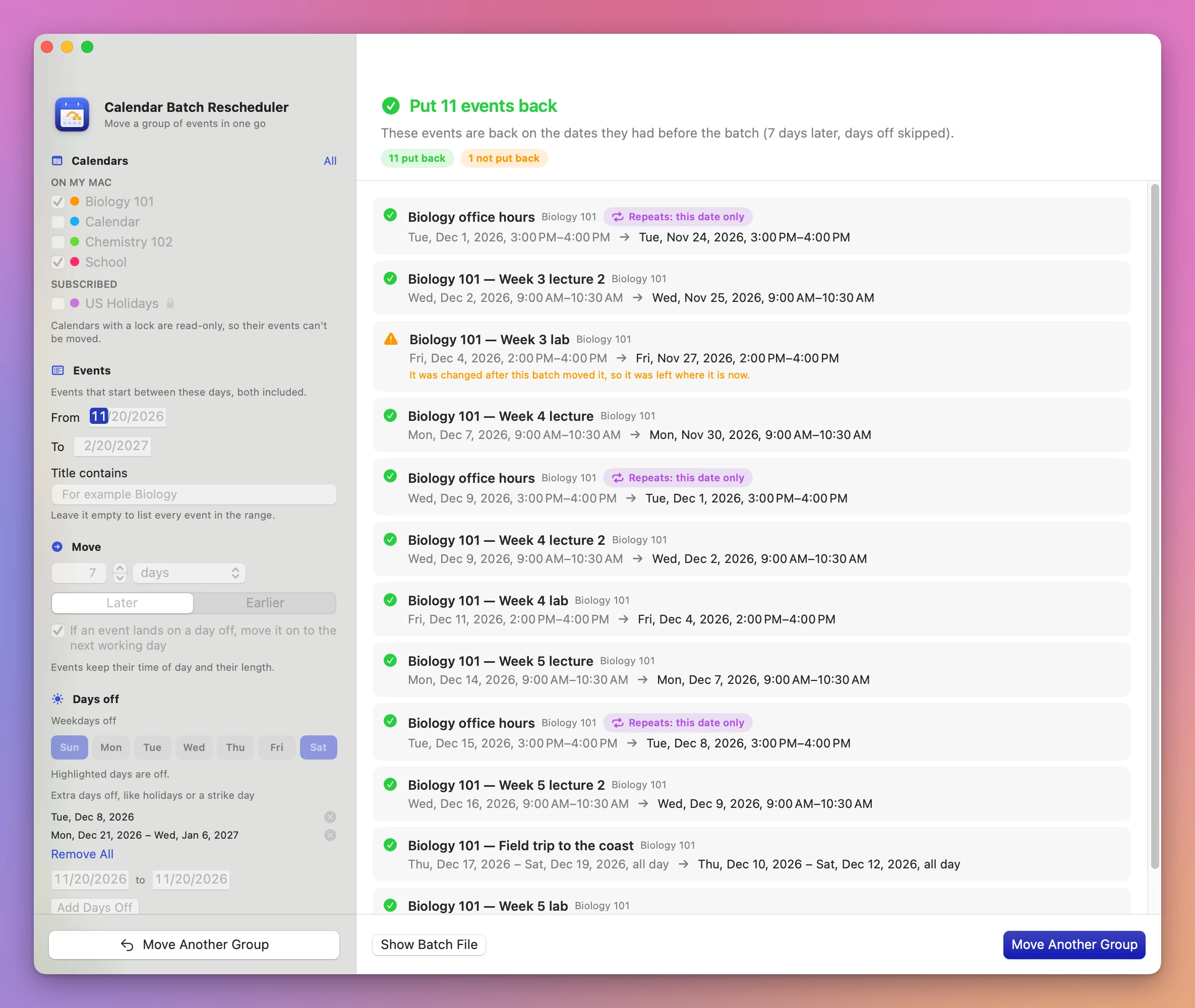
The done screen has Undo This Batch. The start screen lists your Earlier batches, up to five, each with an Undo… button, also after you quit and reopen the app. If you edited one of the moved events by hand in the meantime, the undo leaves it where you put it and says so: “It was changed after this batch moved it, so it was left where it is now.”
Repeating events moved one date at a time
When the range covers some dates of a repeating event, only those dates move, each as “only this event”. The rule of the series never changes, so the dates outside your range stay put.
What it never moves
- Events with invitees or an organizer. The row says “Stays: It has invitees. Move it in Calendar, so they get the new time.” Calendar is where the others get told.
- Events in read-only calendars.
Right before each move, the app reads the event again. If it’s gone, or its time or calendar changed since the preview, it’s skipped and listed with the reason.
Why not move them in Calendar
For three or four events, drag them in Calendar. It’s quicker than opening an app.
Calendar moves an event when you drag it or edit its date. You can select a few events in the same week and drag them together, but they all move by the same amount, inside the view on screen. Nothing skips a weekend or a holiday, there’s no list of what goes where, and you find a clash when you see two events on top of each other.
Repeating events are slower still. Change one date of the weekly office hours and Calendar asks whether you mean all future events or only this one. Ten dates is ten questions.
Edit › Undo in Calendar covers your last few changes while it’s open. Tomorrow, the old dates are gone.
Shortcuts and AppleScript can shift events by a fixed number of days, if you write the script. You get no working days, no list of days off, no preview, no clash check and no undo. Importing a corrected .ics file adds a second copy of every event instead of moving the ones you have, and the notes and alerts you added in Calendar stay on the old copies.
| By hand in Calendar | Calendar Batch Rescheduler | |
|---|---|---|
| Seventeen events | Seventeen drags or edits | One batch |
| Weekends and holidays | You check each new date | Skipped, with the day it skipped |
| Working days | You count on a paper calendar | working days |
| Clashes | You spot them in the week view | Listed before anything moves |
| Dates of a repeating event | A question for each date | Moved one by one, the series untouched |
| Undo | Edit › Undo, while Calendar is open | Every batch saved, undo days later |
What it doesn’t do
- It shifts by days or working days only. It doesn’t move each session into the next session’s slot. A Wednesday session moved by 1 working day goes to Thursday, not to Friday’s class time.
- It doesn’t read a holidays calendar. You pick or type the days off.
- It doesn’t move whole repeating series. Only the dates in your range move, one by one.
- It doesn’t move invitations. Events with invitees or an organizer stay where they are.
- It checks clashes only in the ticked calendars. Tick the calendar with the staff meetings too, and its events count as clashes even when the title filter leaves them out of the move.
- It judges a multi-day event by its first day. A trip that starts on a working day isn’t skipped because its second day is a holiday.
- It doesn’t find duplicates. For events an import added twice, there’s Calendar Duplicate Review. To bring a schedule in from a spreadsheet, there’s Calendar CSV Importer.
Questions
Which calendars does it work with?
It reads the calendars that Calendar on your Mac shows. I tested moving and undoing on calendars stored On My Mac. I haven’t tested iCloud, Google or Exchange calendars. Moved events sync to your other devices like any change you make in Calendar.
Will the people I invited get the new time?
The app doesn’t move events with invitees or an organizer. It lists them as staying, so you can move them in Calendar, which sends the update.
Can I undo a batch next week?
Yes. Each batch is saved to a file, and the start screen lists the last five under Earlier batches with an Undo… button. An event you changed by hand after the batch stays where you put it. A partly undone batch can be undone again later.
What happens to a repeating event?
Only its dates inside your range move, each one as “only this event”. The series keeps its rule and its other dates.
Does anything leave my Mac?
No. The app reads and changes your calendars through macOS, on your Mac. It uses the internet only to check for updates.
What it needs
Calendar Batch Rescheduler runs on macOS 14 Sonoma or later, on Apple silicon and Intel Macs. It needs full access to your calendars.
The Calendar Batch Rescheduler docs walk through each step.
Buy Calendar Batch Rescheduler
$19 plus tax where it applies, paid once.
Download the app from the order page or your Creem receipt, unzip it and move it to Applications. I sign the app with my Apple Developer ID, and Apple notarizes the download.
The app checks for updates once a day. When a new version is ready, click Install and Relaunch. To check anytime, choose Calendar Batch Rescheduler → Check for Updates….