StackPlan: figure out where to deploy your app, and what it'll cost
By Flavio Copes
I built stackplan.dev, a deployment stack advisor. Describe your app, get a recommended hosting stack with real cost estimates. Why I built it and how.
Update, October 2026: I retired StackPlan. stackplan.dev now redirects to my guide on where to host your web app. To compare providers and prices for your app, use my hosting picker.
I shipped a new product: StackPlan.
You describe your app through a questionnaire, a free-text prompt, or a GitHub repo. It recommends where to host it, which services to use, and what they will cost. It also forecasts costs at 100, 1k, 10k, and 100k daily active users.
I mentioned it briefly in my Summer of Code recap. This post is the full story.
Here’s the site in 30 seconds:
Why I built it
AI agents can now handle a lot of the coding. Choosing the architecture and deployment setup still takes work.
An agent can build you a full app in an afternoon. Then you ask “where should I deploy this?” and you get a generic answer, with no real pricing behind it. Hosting costs are scattered across dozens of pricing pages, free tiers change constantly, and the difference between “$0/month” and “$400/month surprise bill” is often one architectural decision made on day one.
I wanted actual numbers for where an app should run, what it will cost, and what happens as it grows.
What it does
The core flow: describe your app at stackplan.dev/new, get a report.
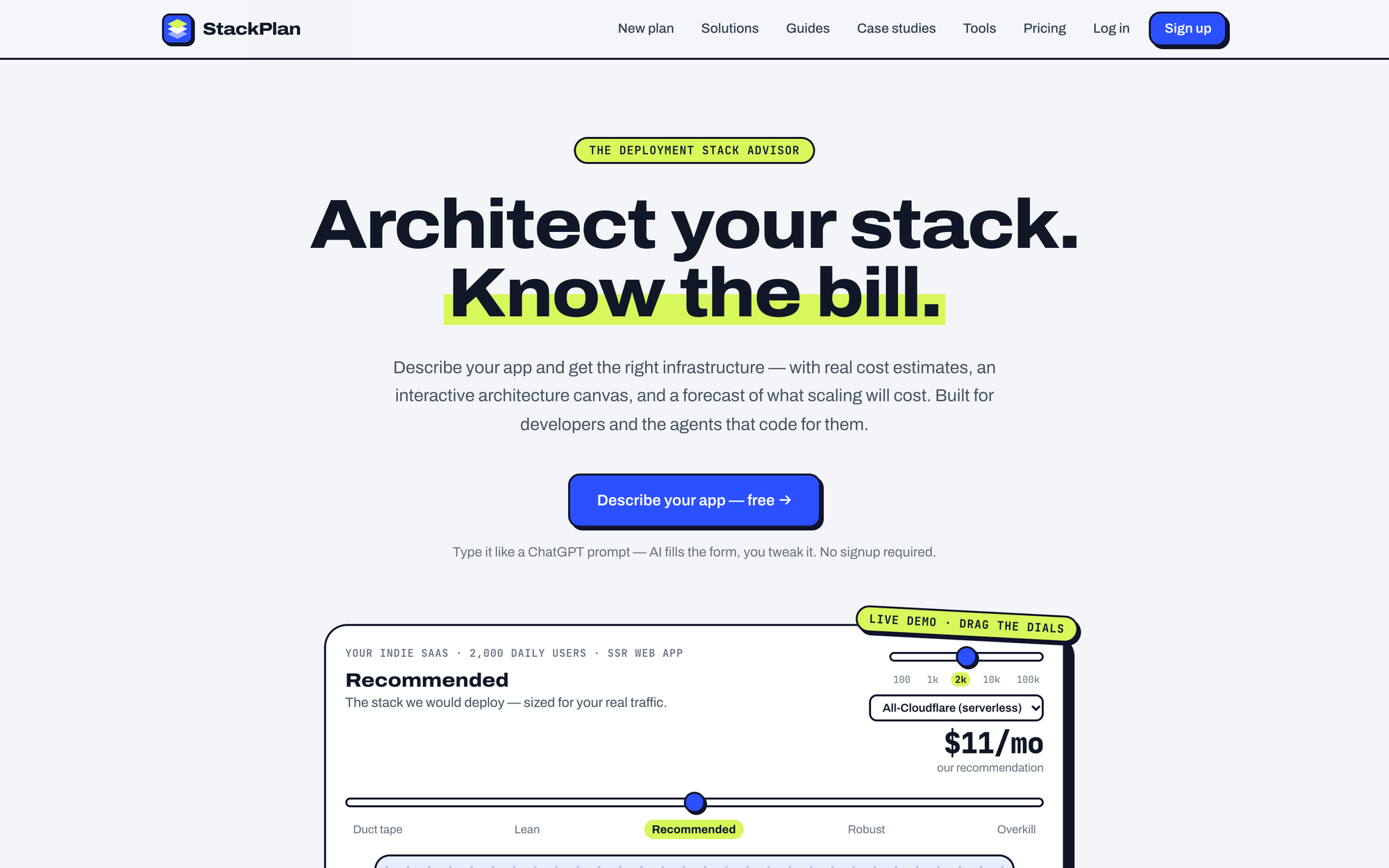
The report centerpiece is an interactive stack canvas, Railway-style: your services as draggable nodes, connected with edges, each with a tier knob. Change a tier and the cost recomputes live in the browser.
My favorite part is the engineering dial: a five-stop control that morphs your stack from “Duct Tape” to “Overkill”. Same app, five philosophies, five price tags. It makes the trade-off visible in a way a pricing table never could.
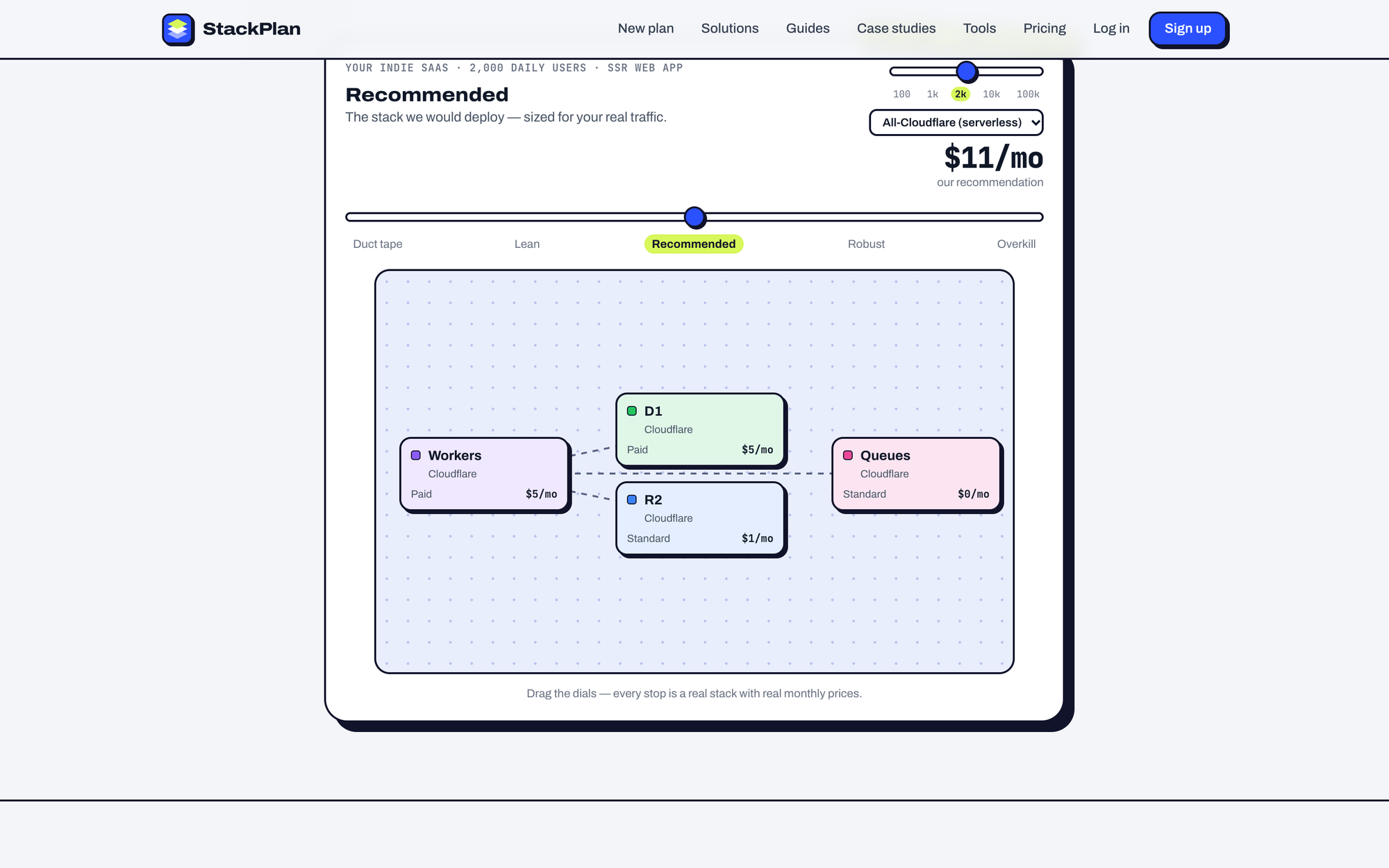
The recommendations use a curated knowledge base of 16 providers, including Cloudflare, Vercel, Railway, Fly.io, Hetzner, AWS, Netlify, and Render. It contains their services and plan tiers. The cost math is deterministic and uses that data. The LLM writes the rationale, but it never invents prices.
StackPlan also has provider comparisons, case studies of real indie businesses, free deployment tools, and an agent API. The API returns the same recommendations as JSON, so a coding agent can ask where to deploy an app during a session.
How I built it
StackPlan runs on the kind of stack it recommends.
It runs on Cloudflare Workers, with the AHA stack: Astro SSR for rendering, htmx for dynamic updates, and Alpine.js for client-side interactivity. It does not use React or a build-heavy frontend.
The data layer is Cloudflare D1. The provider knowledge base, users, and reports live in a SQLite database at the edge, accessed through Drizzle ORM. KV caches LLM responses. Every public form is protected by Turnstile. LLM calls go through Cloudflare AI Gateway, so I get logging and caching on every request.
Auth is Better Auth, billing is Polar, transactional email is Resend. Deploys are one command with wrangler.
I went from an empty folder to production in 6 days, working with Cursor agents. The agents handled most of the planning, implementation, and testing. I provided direction and reviewed the work. An AI agent now checks provider prices daily and files an update proposal when something changes.
What you can buy
StackPlan is free to explore. Every report shows your top recommended stack in full, including the canvas, cost estimate, and scaling forecast. The alternative stacks are blurred.
Two ways to unlock more:
- Report Unlock, $20 one-time gives you every alternative stack and full scaling forecast for one report. It stays yours with no subscription.
- Pro, $20/month fully unlocks every report and lets you save up to 10 apps. It also re-evaluates costs when providers change pricing and sends infrastructure update alerts for your stacks.
If you’re about to deploy something and you’re not sure where, give it a try. And if you have feedback, I’d love to hear it.
Want me to talk about your product? You can sponsor this site.
Related posts about news: