I launched migratingto.dev: exact playbooks for moving between platforms
By Flavio Copes
I launched migratingto.dev, a library of versioned migration playbooks with transfer breakdowns, timelines, rollback plans, and verification checks.
Today I launched migrating to.
migrating to is a library of exact playbooks for moving from one software platform to another.
It covers migrations like:
- WordPress to Astro
- Heroku to Render
- Firebase to Supabase
- Jira to Linear
- Mailchimp to ConvertKit
- Google Drive to Dropbox
- Stripe Billing to Polar
- Terraform to OpenTofu
The launch catalog contains 354 migration paths across 151 platforms.
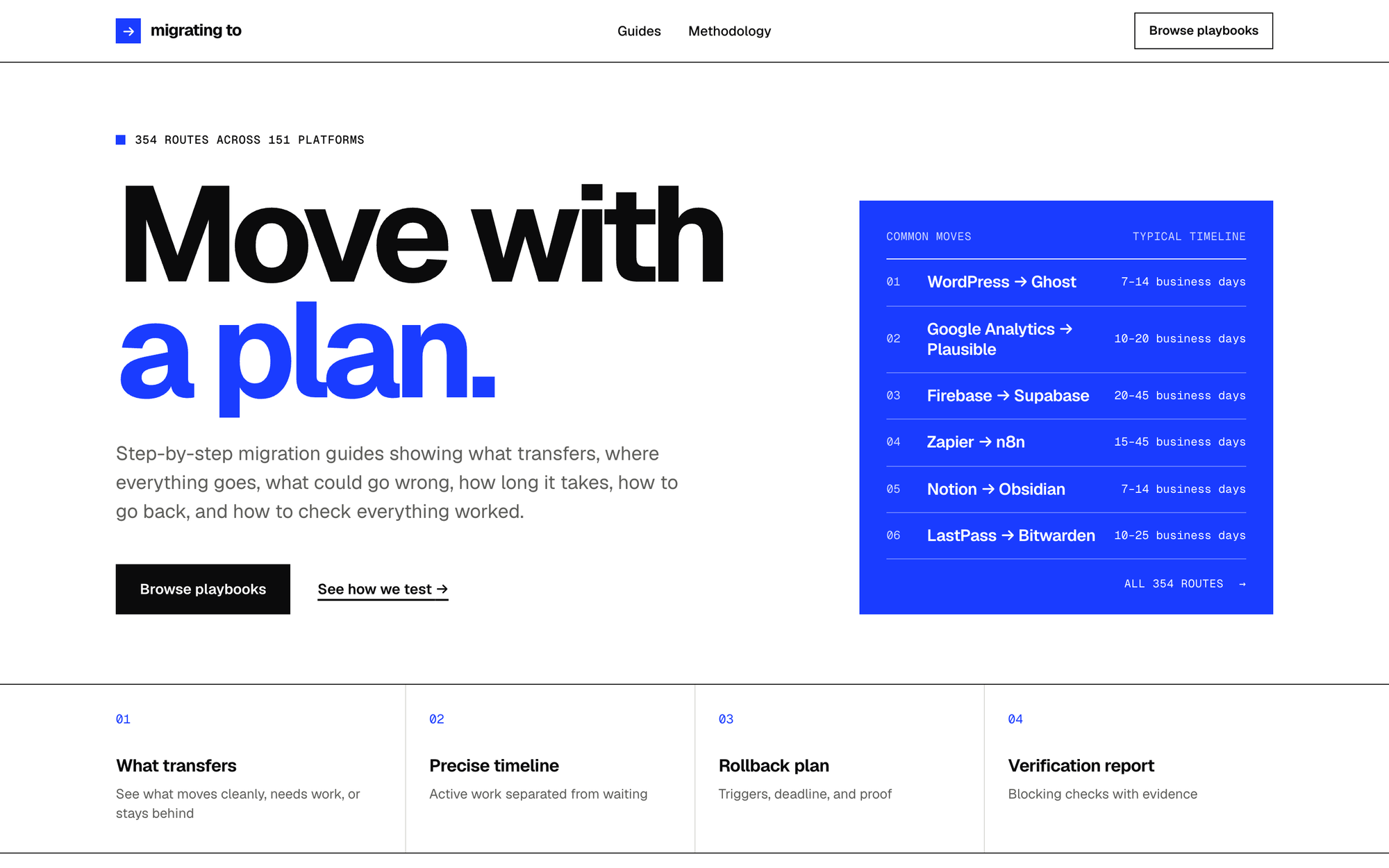
But the number of guides is not the point.
The point is knowing what you might lose before you move.
Here’s the site in 30 seconds:
Why I built it
Most migration guides explain how to export from one platform and import into another, then stop.
But a real migration is not just moving rows from A to B.
You also need to know what happens to URLs, media, permissions, automations, metadata, integrations, history, and all the small behaviors your current system accumulated over time.
Some things transfer cleanly, while others need transformation or must be rebuilt by hand. A few cannot move at all.
The source platform documents how to export. The destination documents how to import. Nobody owns the gap between them.
That gap is where migrations go wrong.
A new site can look correct while old URLs return 404. A CRM may contain every contact but lose consent history, and an analytics platform may collect events with different definitions. You can also move every file to new storage and still get the permissions wrong.
I built migrating to around two ideas:
- Know the loss before the first irreversible step.
- Prove the result before removing the old system.
Who it is for
migrating to is for people responsible for the result of a migration.
That includes:
- developers moving an application or website
- founders replacing a tool that no longer fits
- teams planning an infrastructure or data move
- agencies migrating client projects
- consultants who need a repeatable operating plan
- technical managers evaluating a move before approving it
You can also use it before deciding to migrate.
The transfer breakdown often matters more than the procedure. It shows whether the destination is a real replacement or just looks similar from the product page.
The site does not move the data for you.
It gives you the plan, the risks, the rollback point, and the checks needed to know the move worked.
How a playbook works
You start by choosing where you are and where you want to go.
Every playbook opens with the important answers:
- what transfers
- what needs manual work
- what will be lost
- how risky the move is
- how much active and elapsed time to expect
- when the information was reviewed
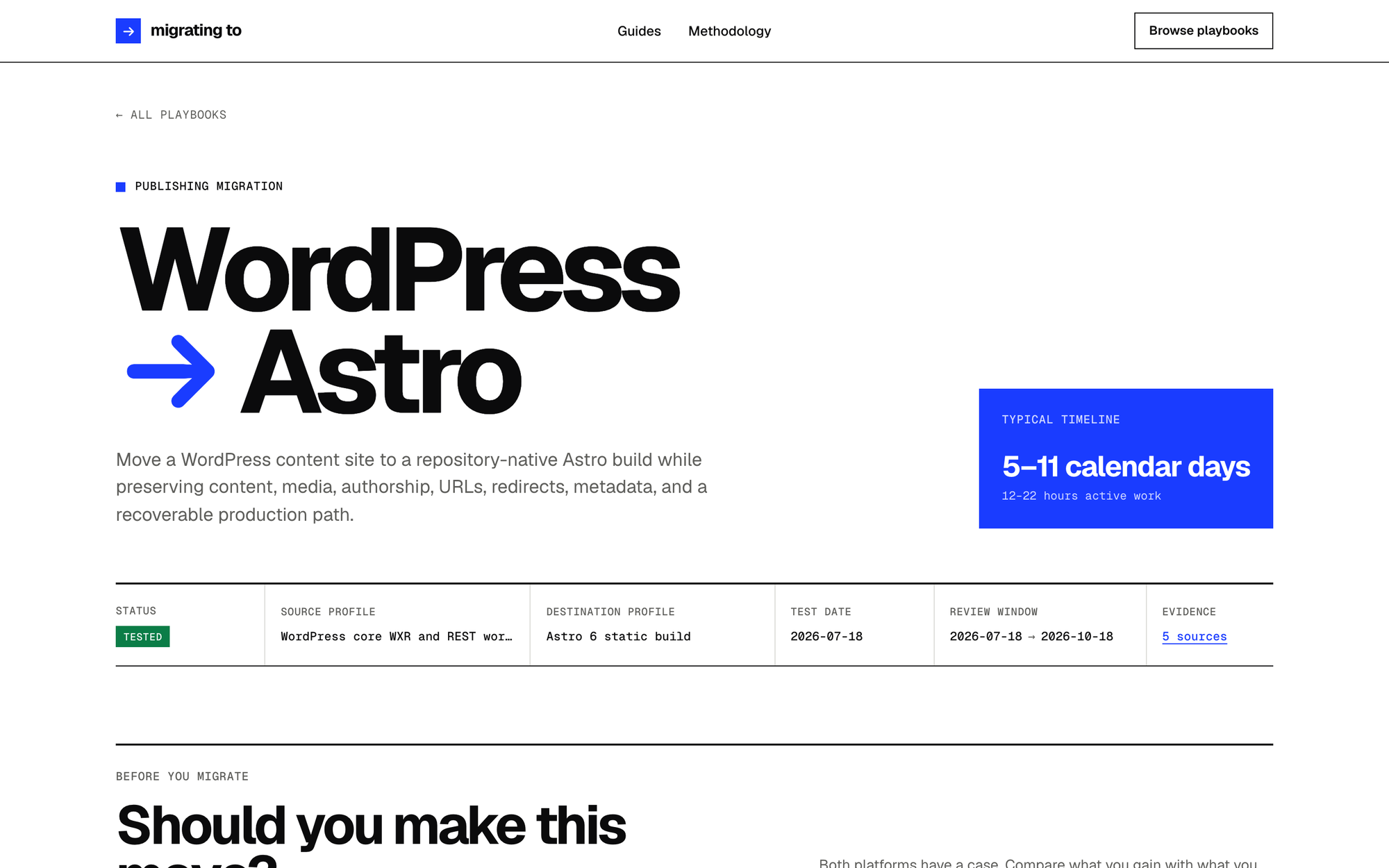
Each guide then covers assumptions, a transfer breakdown, field mappings, backup instructions, transformations, risks, a phased timeline, stop/go gates, cutover steps, rollback triggers, verification checks, and post-migration cleanup.
The verification section is interactive. You can work through the checks and see how many passed.
Some routes also include reports from people and companies that completed the migration. First-person accounts are preferred. Vendor case studies are labeled clearly.
Every guide shows its source and destination versions, official sources, review date, next review date, and current status.
A guide can be tested, needs review, draft, or retired. I would rather show uncertainty than present old information as current fact.
How I built it
I did not create 354 separate Astro pages. The site is data-driven, with every migration stored as a structured JSON document following one shared contract.
The shape looks like this:
{
  slug: 'wordpress-to-astro',
  source: 'WordPress',
  destination: 'Astro',
  status: 'tested',
  testedVersions: {},
  sources: [],
  assumptions: [],
  fieldMappings: [],
  backup: {},
  transformations: [],
  risks: [],
  timeline: {},
  cutover: {},
  rollback: {},
  verification: [],
  cleanup: {},
}
Astro loads those files as a content collection. Zod checks the structure during the build.
One dynamic route creates every guide:
export async function getStaticPaths() {
  const playbooks = await getCollection('playbooks')

  return playbooks.map(entry => ({
    params: { slug: entry.data.slug },
    props: { entry },
  }))
}
The shared page turns the data into the transfer breakdown, timeline, risk list, procedures, verification report, related routes, and sources.
This keeps presentation separate from migration knowledge.
It also means I can improve one component and update every guide at once.
The hard part was building a trustworthy catalog
Generating a lot of pages is easy now.
Generating a lot of pages that look authoritative is also easy. That is a problem.
The difficult part was building constraints around the content.
Every live playbook must have at least:
- 2 evidence sources
- 4 explicit assumptions
- 10 entries covering what transfers and what does not
- 8 field mappings
- 2 transformation procedures
- 3 risks
- 5 timeline phases
- 3 rollback triggers
- 8 verification checks
The validator also rejects duplicate routes, duplicate source links, placeholder text, invalid dates, incomplete cleanup steps, and playbooks without blocking verification checks.
At launch, the catalog contains more than 4,000 entries covering what transfers and what does not, 2,800 verification checks, and 800 source references.
Those numbers are not proof that every guide is correct.
They are proof that every guide has enough structure to be reviewed, challenged, and improved.
A migration is directional
Another challenge was the route graph.
WordPress → Astro is not the reverse of Astro → WordPress.
The loss, field mapping, backup, risks, and rollback plan all change.
Even similar products use different names for the same concepts. A platform may have projects where another has workspaces, or contacts where another has subscribers. One export can include history while another only includes current state.
So every direction is its own playbook.
I built validation around the graph too. Platform names are normalized, every route must be unique, and every live source has multiple possible destinations.
This also powers the related-route suggestions. If the destination does not look right after reviewing what transfers and what does not, you can compare another path from the same source.
Official documentation is not enough
Official documentation is the starting point.
It tells us what an export contains, which APIs exist, and what the destination accepts.
It rarely tells us what happened when someone tried the complete move.
I added field reports to cover that missing part.
I built a separate research ledger for all routes. Sources must describe the exact migration, not a generic product comparison. Summaries are paraphrased, recommendations are attributed, duplicate links are rejected, and vendor case studies are visibly different from independent reports.
If I cannot find a credible report, the section stays hidden.
No placeholder is better than invented experience.
This is a result of my software factory
migrating to is another result of my software factory.
I use a repeatable system made of plans, repository instructions, specialized agent roles, bounded tasks, review gates, and automated checks.
AI coding agents did much of the production work. They helped research platform families, build migration routes, create components, expand the catalog, and check independent parts of the product.
My job was product direction, defining the contracts, splitting the work, reviewing what came back, and deciding what was good enough to keep.
The factory made the scale possible.
It did not make judgment optional.
This project made that very clear. An agent can create another 100 migration pages quickly. The real question is whether those pages deserve to exist and what confidence label they should carry.
The software factory increases output. The schemas, statuses, sources, and review process keep that output under control.
The development stack
migrating to uses the AHA Stack:
- Astro generates the complete static site
- HTMX makes navigation feel faster while keeping normal links
- Alpine.js runs the catalog filters and interactive verification checklists
The rest is deliberately small:
- TypeScript defines the shared data contracts
- Astro content collections load the JSON playbooks
- Zod validates every playbook at build time
- plain CSS handles the design
- Node scripts generate manifests and validate the catalog
- a Python script creates the printable migration kit
There is no database, account system, API, or server-rendered application.
The full catalog is generated as static HTML.
The deployment stack
The site is deployed to Cloudflare Pages.
The build command does more than generate HTML:
npm run buildIt regenerates the catalog manifest, validates all playbooks, checks the route graph, validates field reports, runs astro check, builds the static site, and confirms every expected route exists in dist.
If a migration file breaks the contract, the deploy stops.
There is no Astro adapter, serverless function, environment variable, secret, or database migration involved in a release.
Cloudflare serves the generated pages and assets. The small interactive parts run in the browser.
How this can evolve
The first job is not adding more routes.
It is reviewing and testing the routes already there.
I want to deepen the most useful playbooks, add more first-hand field reports, keep platform versions current, and make review status more useful over time.
The next layer is migration kits.
The online guides will keep the complete safety information free. A paid kit can package the same work into a polished PDF, an editable field-mapping worksheet, a risk register, a project timeline, cutover and rollback checklists, and a fillable verification report.
For larger migrations, the same system can also support professional planning and execution. The playbook becomes the starting point, then the real account size, constraints, integrations, and acceptable losses shape the project.
I also want demand to guide the catalog.
Searches, requests, and field reports can show which routes deserve deeper testing. I do not want to add pages only because the factory can produce them.
Try it
Open migrating to, choose the platform you are leaving, and see where you can go.
The playbooks are free and do not require an account.
If you completed one of these migrations, found a missing risk, or have a route you want me to add, let me know.
Want me to talk about your product? You can sponsor this site.
Related posts about news: