
An app by Flavio
Wash Sale Checker
Load the trade history CSVs from every brokerage account, IRAs included, and see each sale at a loss with a purchase of the same symbol within 30 days, the loss that may be disallowed and where it goes, on your Mac.
Buy Wash Sale Checker · $19One-time purchase. Plus tax where it applies.
macOS 14 or later · Apple silicon and Intel
Latest version 1.0.1, released November 22, 2026
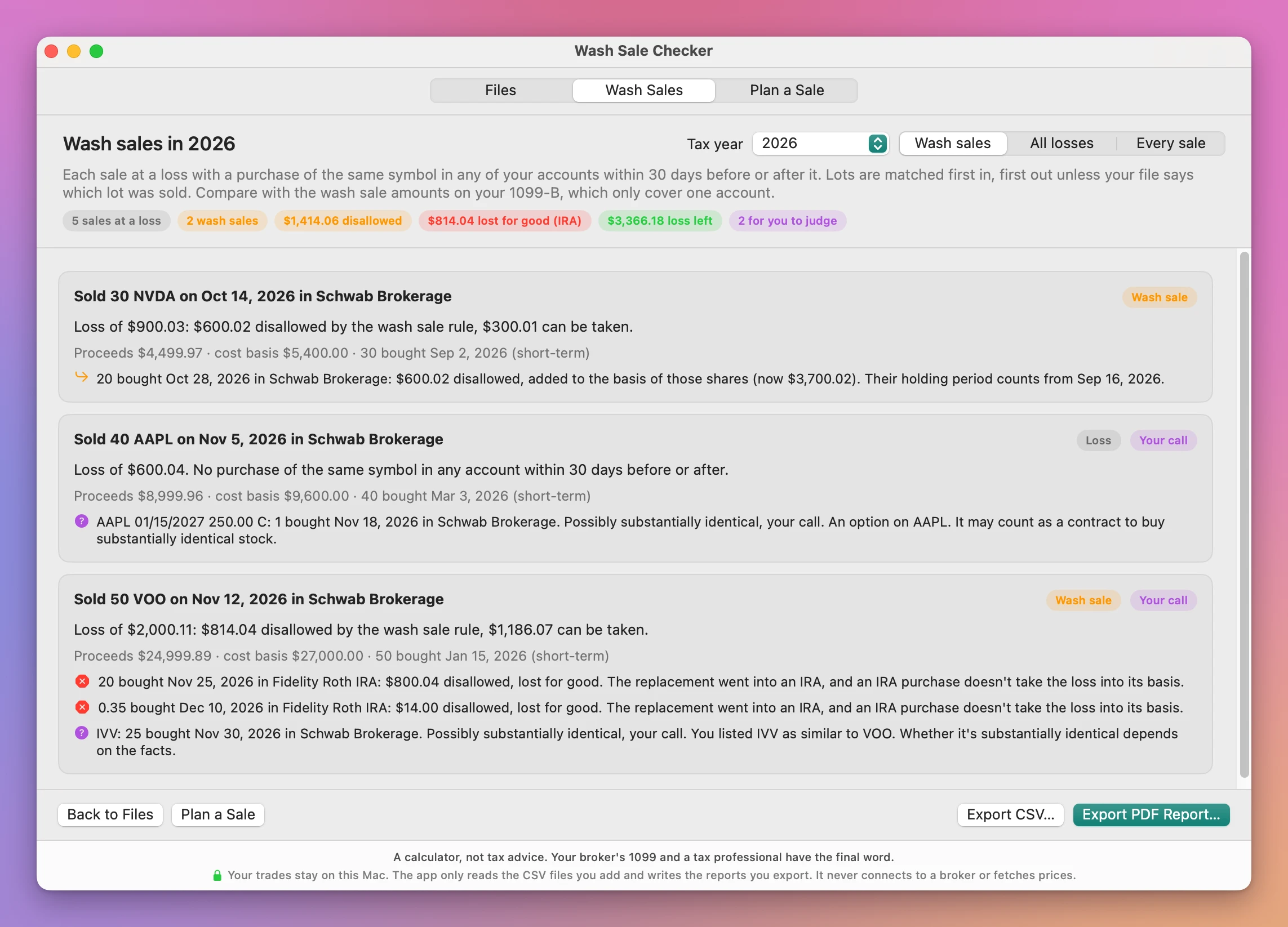
In November you sold 50 shares of VOO at a $2,000 loss in your taxable account at Schwab. Two weeks later you bought 20 VOO in your Roth IRA at Fidelity, and in December the IRA reinvested a dividend into a few more.
Schwab’s 1099-B won’t mention it. A broker reports a wash sale only when the replacement shares were bought in the same account. The rule itself looks at every account you own, and when the replacement lands in an IRA, the part of the loss it washes doesn’t move into any basis. It’s gone.
Wash Sale Checker reads the trade history CSVs from all your accounts together. Add the files, mark which accounts are IRAs, click Check for Wash Sales, and every sale at a loss with a purchase of the same symbol within 30 days before or after shows up with the amount that may be disallowed and where it goes.
A calculator, not tax advice. Your broker’s 1099 and a tax professional have the final word. The rule described here is the US federal wash sale rule. The accounts and trades on this page are made up.
Who it’s for
- Someone harvesting losses in December. You sold VOO at a loss in a taxable account, and the IRA’s automatic dividend reinvestment bought VOO the same month. Nobody’s 1099 connects the two.
- Couples with accounts at two brokers. One of you sells a stock at a loss, the other buys it two weeks later in their own account. Pub 550 counts a spouse’s purchase too.
- Traders who split their accounts. Long-term holdings at Schwab, trading at Robinhood or Webull, and the same tickers in both. Each broker only sees its half.
- People who check before they sell. “If I sell NVDA today, which dates does the rule look at, and did I already buy some in another account?” The Plan a Sale tab answers that with the dates and the purchases already inside the window.
- Anyone who hands a folder to a tax preparer. Export PDF Report… saves one PDF with every cross-account wash sale, to put next to the 1099s.
The rule, in short
IRS Publication 550 says a wash sale happens when you sell stock or securities at a loss and, within 30 days before or after the sale, you buy substantially identical stock or securities, acquire a contract or option to buy them, or acquire substantially identical stock for your IRA or Roth IRA. A purchase by your spouse counts as well.
The disallowed loss is added to the cost of the new shares, and their holding period includes the time you held the old ones. The IRA case is the exception: Rev. Rul. 2008-5 holds that the loss is disallowed and the basis in the IRA isn’t increased.
Publication 550 also says what the broker reports: box 1g of Form 1099-B shows a wash sale only when the replacement had the same CUSIP and was bought in the same account. You can’t deduct a wash sale loss even when the 1099-B doesn’t show it.
From your CSV exports to a list of wash sales
- Export the trade history from each broker. The app reads the CSV layouts of Charles Schwab, Fidelity, Interactive Brokers (Flex Query and Activity Statement), Robinhood and Webull as they are. Any other CSV works once you pick its columns.
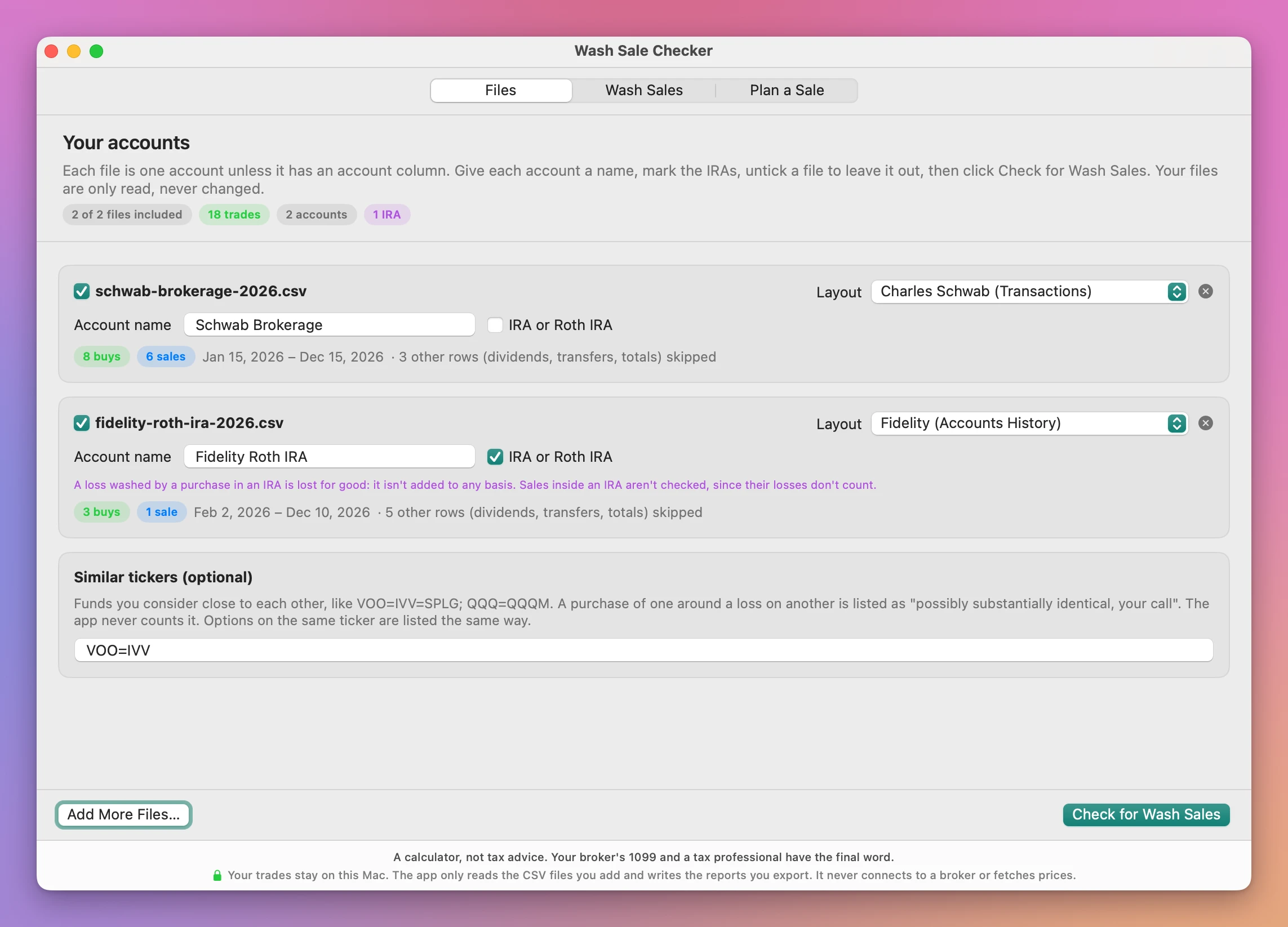
- Add the files. Click Add CSV Files… or drop them on the window. Each file gets a card with the layout it detected, the number of buys and sales, the date range, and how many other rows (dividends, transfers, totals) it skipped.
- Name the accounts and mark the IRAs. Each file is one account unless it has an account column. Type a name like “Fidelity Roth IRA” and tick IRA or Roth IRA where it applies.
- List similar funds, if you want. In Similar tickers, type groups like
VOO=IVV=SPLG; QQQ=QQQM. A purchase of one of them around a loss on another is flagged for you to judge, never counted. - Click Check for Wash Sales. The Wash Sales tab lists each sale at a loss that has a purchase of the same symbol within the window, with the matched purchases and what happens to the loss.
- Export. Export PDF Report… (Command-E) or Export CSV… (Shift-Command-E).
What you get
Each wash sale in plain sentences
A card per sale: “Sold 30 NVDA on Oct 14, 2026 in Schwab Brokerage”, the loss, the part disallowed and the part that can be taken, the proceeds, the cost basis, the lots sold and whether it’s short- or long-term. Under it, each purchase that washed some of the loss, with what happens to that amount:
- In a taxable account, it’s added to the basis of the replacement shares, with their new basis and the date their holding period counts from.
- In an IRA, it’s lost for good.
When only part of the shares were bought back, only that part of the loss is disallowed. The pills at the top add it up: sales at a loss, wash sales, the dollars disallowed, the dollars lost for good through an IRA, the loss left, and how many purchases are yours to judge. A Tax year picker and a Wash sales / All losses / Every sale filter change what’s listed.
The cases it leaves to you
Whether two different funds are “substantially identical” depends on the facts, so the app doesn’t decide it. A purchase of a ticker you listed as similar, or of an option on the same stock, shows in purple as “Possibly substantially identical, your call”, and it’s never added to the disallowed total.
Sales with no matching purchase in your files (shares bought before the earliest file, say) go into a Couldn’t check card, unless the row has its own cost basis column.
Plan a Sale: the window before you sell
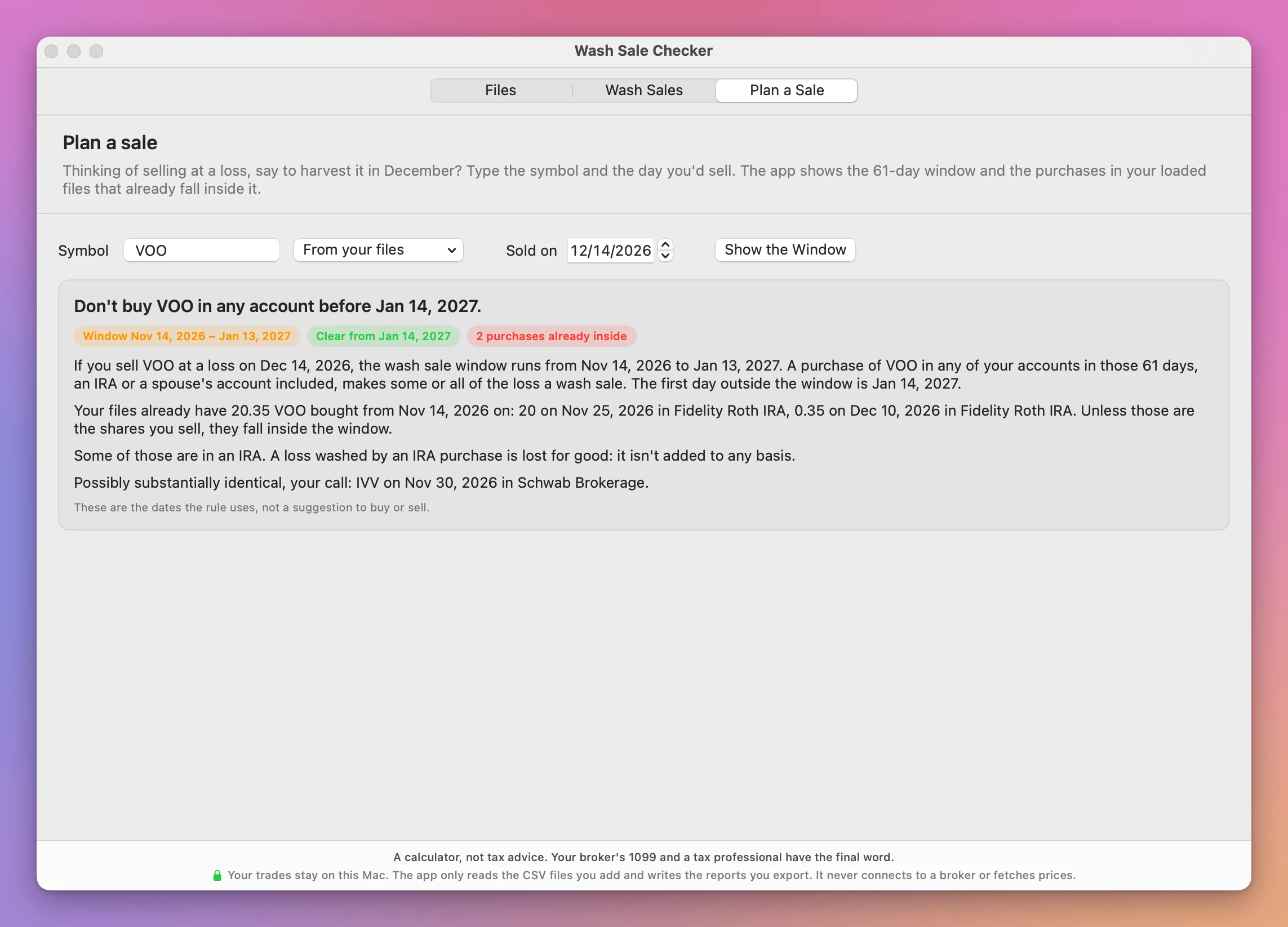
Type a symbol and the day you’d sell, and Show the Window gives the 61-day window, the first day outside it, and every purchase in your loaded files that already falls inside, in any account. It says when some of them are in an IRA. The dates work with no files loaded, too.
Any CSV, with the columns matched on screen
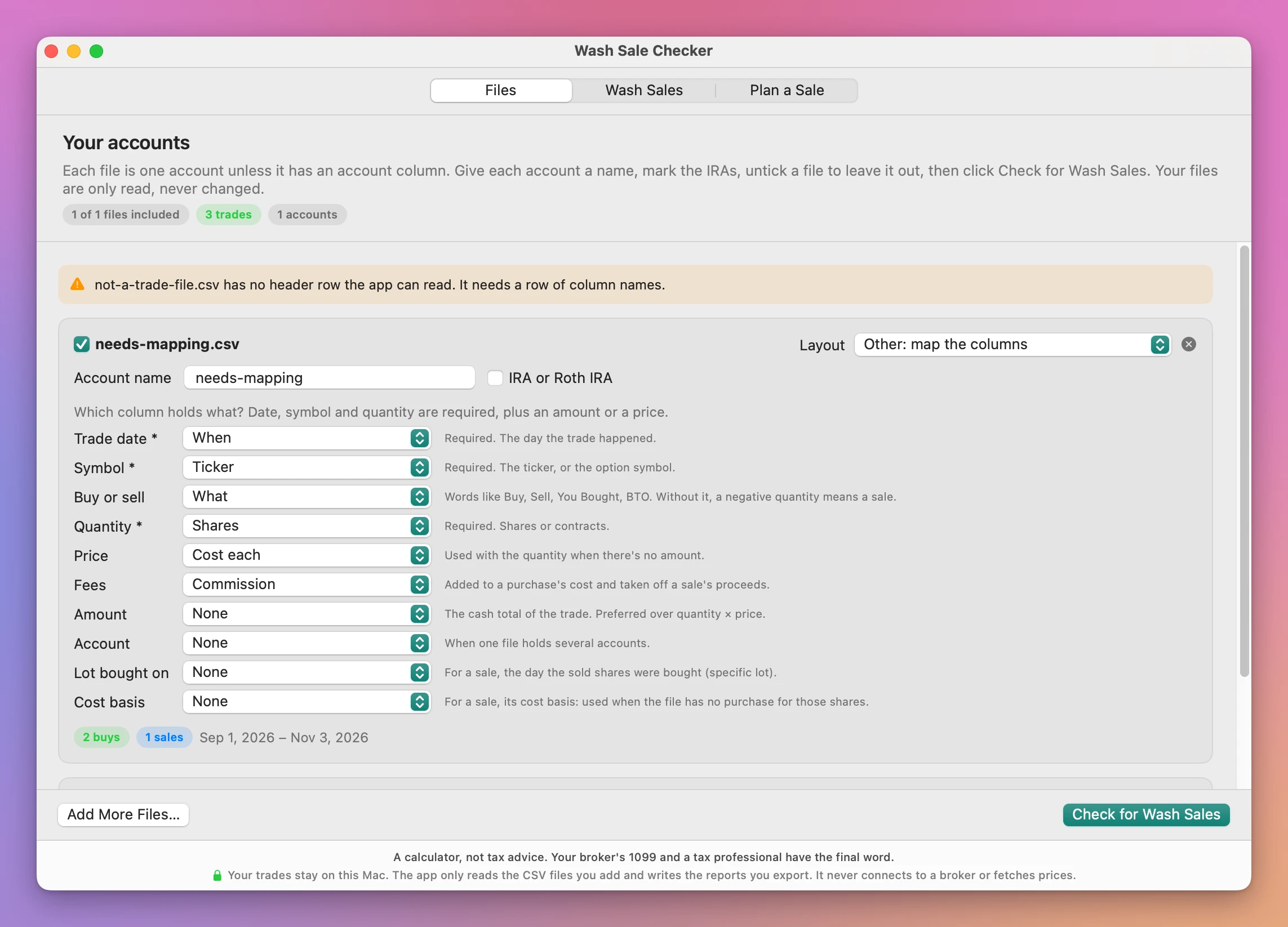
A file the app doesn’t recognize gets the Other: map the columns layout: a picker for trade date, symbol, buy or sell, quantity, price, fees, amount, account, lot bought on and cost basis, with common column names already guessed. A file with no header row gets a sentence saying so.
The arithmetic, tested against the IRS examples
Lots are matched first in, first out, unless the sale row names the lot. Replacement shares are matched in purchase order and used once. A wash on shares that are themselves sold at a loss later carries the basis and holding period along the chain. The app’s tests reproduce Publication 550’s own wash sale examples with the publication’s dates and amounts, plus the 30-day versus 31-day edge on both sides.
Your trades stay on your Mac
The app only reads the CSV files you add and writes the reports you export. It never connects to a broker, never fetches prices and has no account.
Why not use the 1099-B, a spreadsheet or tax software
Your broker’s 1099-B is the right place to start. If you have one taxable account at one broker and no IRA buying the same funds, it already covers you, and you don’t need this app. It stops at the account’s edge: a purchase at another broker, in your IRA or in your spouse’s account never shows up in box 1g.
A spreadsheet can do it. You merge exports with different layouts, apply first-in, first-out lots, match replacement shares in order, split partial washes, carry the basis and holding period through chains, and redo it each time you trade in December. One day off at the edge of the window (30 days versus 31) changes the result.
Tax software like TurboTax takes the 1099 numbers as given, and it doesn’t look across accounts. Trader tax tools like TradeLog do find cross-account wash sales. They’re subscriptions built for active traders, and they work from your data on their service.
| Broker 1099-B | Spreadsheet | Tax software | Wash Sale Checker | |
|---|---|---|---|---|
| Purchases in another account | No | If you build it | No | Yes |
| Purchases in an IRA | No | If you build it | No | Yes, marked lost for good |
| Basis and holding period carried | Same account only | Your formulas | From the 1099 | Yes, with the dates |
| Before you sell | No | By hand | No | Plan a Sale |
| Where your trades go | Your broker | Your file | The vendor | Nowhere, read on your Mac |
| Cost | Free | Free | Varies | $19 once |
What it doesn’t do
- It isn’t tax advice, and it doesn’t file anything. It’s a calculator for comparing with your 1099s. US federal rule only.
- Same ticker only. Options on the same stock and tickers you list as similar are flagged as “your call”, never counted. Option contracts are matched only with the exact same contract.
- Some trades are left out, with a sentence each. Short sales, buy to close, option expirations, assignments and exercises.
- No corporate actions. Splits, mergers, spin-offs and ticker changes aren’t handled. A split shows up as odd quantities.
- No average cost. Lots are first in, first out, or the lot named on the sale row. Mutual funds on average cost aren’t supported.
- The broker layouts come from public descriptions. They haven’t been tested with a real export from each broker, and the Fidelity and Interactive Brokers Activity Statement layouts are the least certain. If a file doesn’t read right, pick Other and match the columns.
- Nothing is saved between launches except the similar tickers. You add the files again each time.
Questions
Is this telling me what to do with my taxes?
It isn’t. It applies the rule to the trades in your files and shows the arithmetic. Whether a result applies to your return is for you and your tax professional, with your broker’s 1099 next to it.
Why doesn’t my 1099-B show these?
Box 1g covers a wash sale only when the replacement was bought in the same account with the same CUSIP. A purchase in another account, an IRA or a spouse’s account is outside what the broker sees.
Does it decide whether two funds are substantially identical?
It doesn’t. List funds you consider close in Similar tickers, and a purchase of one around a loss on another is shown for you to judge. It never goes into the totals.
Does anything get uploaded?
The app reads your CSV files on your Mac and writes only the reports you save. It uses the internet only to check for and download updates.
What it needs
Wash Sale Checker runs on macOS 14 Sonoma or later, on Apple silicon and Intel Macs.
The Wash Sale Checker docs walk through each step.
Buy Wash Sale Checker
$19 plus tax where it applies, paid once.
Download the app from the order page or your Creem receipt, unzip it and move it to Applications. I sign the app with my Apple Developer ID, and Apple notarizes the download.
The app checks for updates once a day. When a new version is ready, click Install and Relaunch. To check anytime, choose Wash Sale Checker → Check for Updates….