
A developer tool by Flavio
Chip Pops
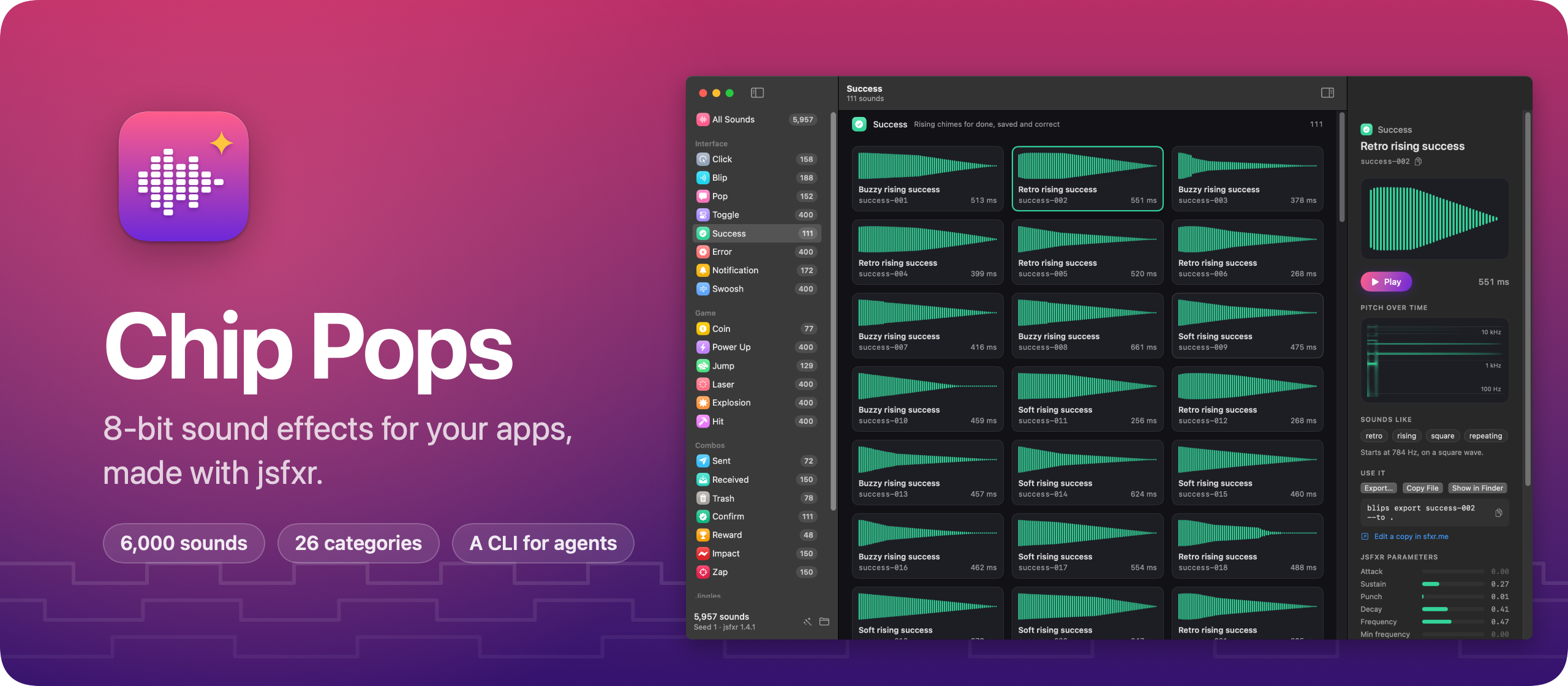
About 6,000 8-bit sound effects for apps and games, from clicks to fanfares. Hear them with the arrow keys and drag the WAV into your project.
Buy Chip Pops · $20One-time purchase. Tax included. Source code included.
macOS 14+
Latest version 1.5.0, released November 20, 2026
$20 including tax, one-time purchase.
The sound takes longer than the feature
You’re adding a “saved” chime to your app, or a coin sound to a little game. The code is five minutes. Then you spend an hour on sound sites, downloading packs, unzipping them, and opening 40 files called sfx_017.wav to find out what they sound like. Then you wonder about the license.
Chip Pops is a Mac app and command line tool with about 6,000 8-bit sound effects for apps and games: clicks, toggles, success chimes, errors, notifications, coins, lasers, explosions, and short jingles like a victory fanfare. Click a sound to hear it, press an arrow key to hear the next one, then drag the file into your project. The sounds are yours to use in anything you make, free or commercial, with no credit needed.
Here it is in 80 seconds, on a test Mac. The screen recording has no sound, so I put the WAV files the app played at those moments back in. The Pocket Plants project in the video is made up:
I make a lot of small apps, and most of them could use a sound or two: a click when you press a button, a chime when something is saved. Every time, I ended up digging through sound packs. I wanted a library I could pick from in a minute, and that the AI agents building my apps could pick from too.
Who it’s for
- Indie Mac and iOS developers. Your to-do app needs a sound when a task is checked off, and a softer one when it’s deleted. Pick a success chime and a trash combo, drag both into Xcode, and you’re done before the coffee gets cold.
- Game jam entrants. You have 48 hours and no sound designer. You need a jump, a coin, a hit, a power up and a game over tune that sound like the same console. Chip Pops has them all in one window, in one style.
- Web developers making browser games. Every sound is a 16-bit WAV that plays in an
<audio>tag or the Web Audio API. Export a whole category into yourassetsfolder with a right-click. - Developers who build with coding agents. You tell Claude Code “add a sound when a note is saved”. The agent finds candidates with the
blipscommand, asks you to listen, and copies the one you pick into the project with a proper name. - Teachers and hobbyists. Your students are making their first game and want sounds nobody else in class has. Explosions alone has 400 different ones.
From “it needs a sound” to a file in your project
- Open Chip Pops and pick a category in the sidebar, say Success.
- Click the first sound to hear it. The arrow keys move to the next one and play it. Space plays or stops the selected sound.
- When you find the one, drag it into Xcode or a Finder folder. Dragged files are named after the sound’s ID, like
success-003.wav. - Or press ⌘E to save it with the name it has in your app, like
saved.wav. - Write down the ID,
success-003. It names the same sound next year, in another project.
Going through a category of 100 sounds with the arrow keys takes a few minutes.
26 categories
Chip Pops makes its sounds with jsfxr, the JavaScript port of DrPetter’s sfxr, which he made for the Ludum Dare game jam in 2007. I wrote a recipe for each kind of sound an app needs, and Chip Pops rolls the sounds from those recipes.
The sidebar groups them in four:
- Interface: click, blip, pop, toggle, success, error, notification and swoosh.
- Game: coin, power up, jump, laser, explosion and hit.
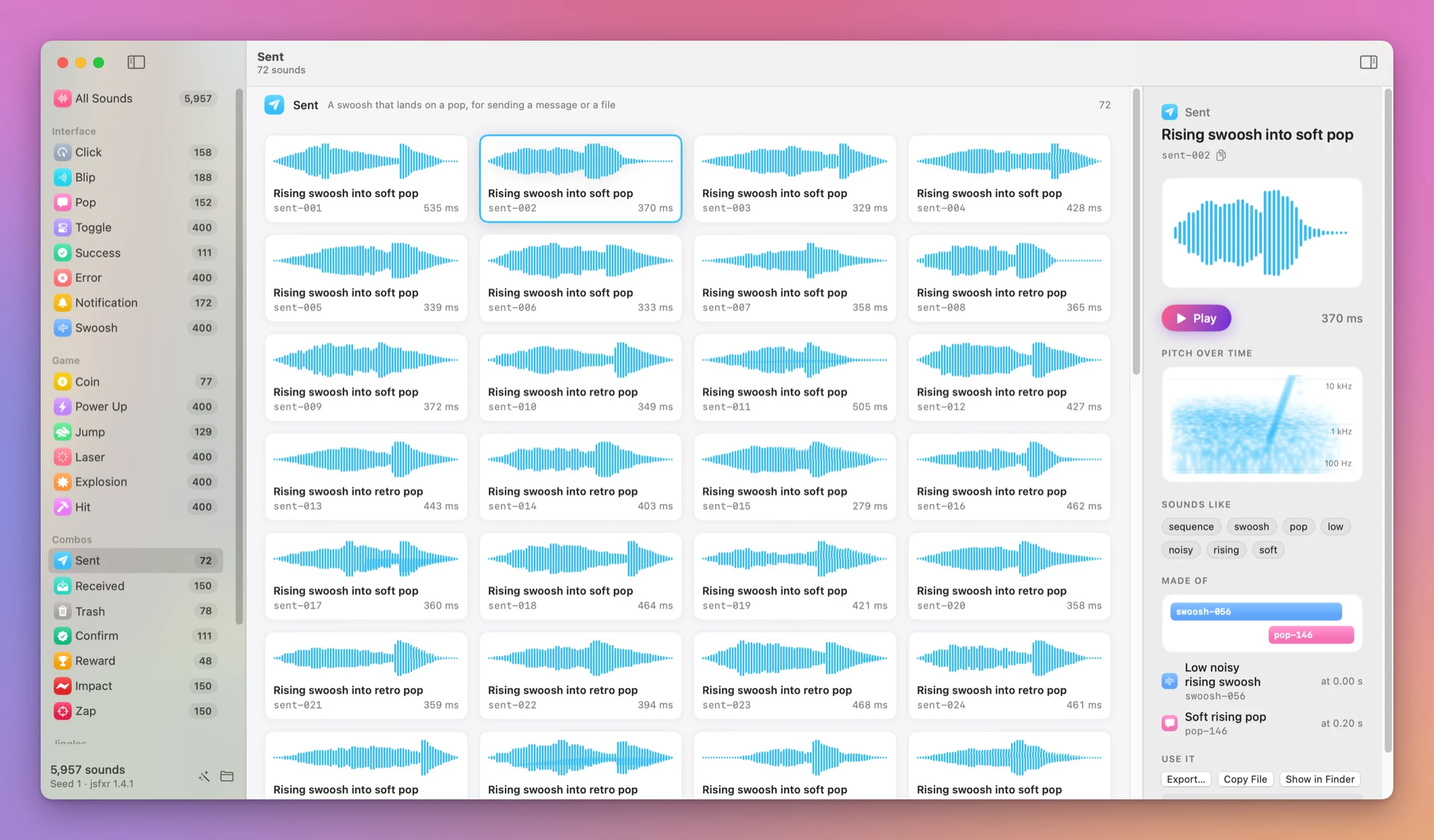
- Combos, two sounds in one: sent is a swoosh that lands on a pop, trash is a falling swoosh into a crunch, reward is a coin stacked on a power-up. There are also received, confirm, impact and zap.
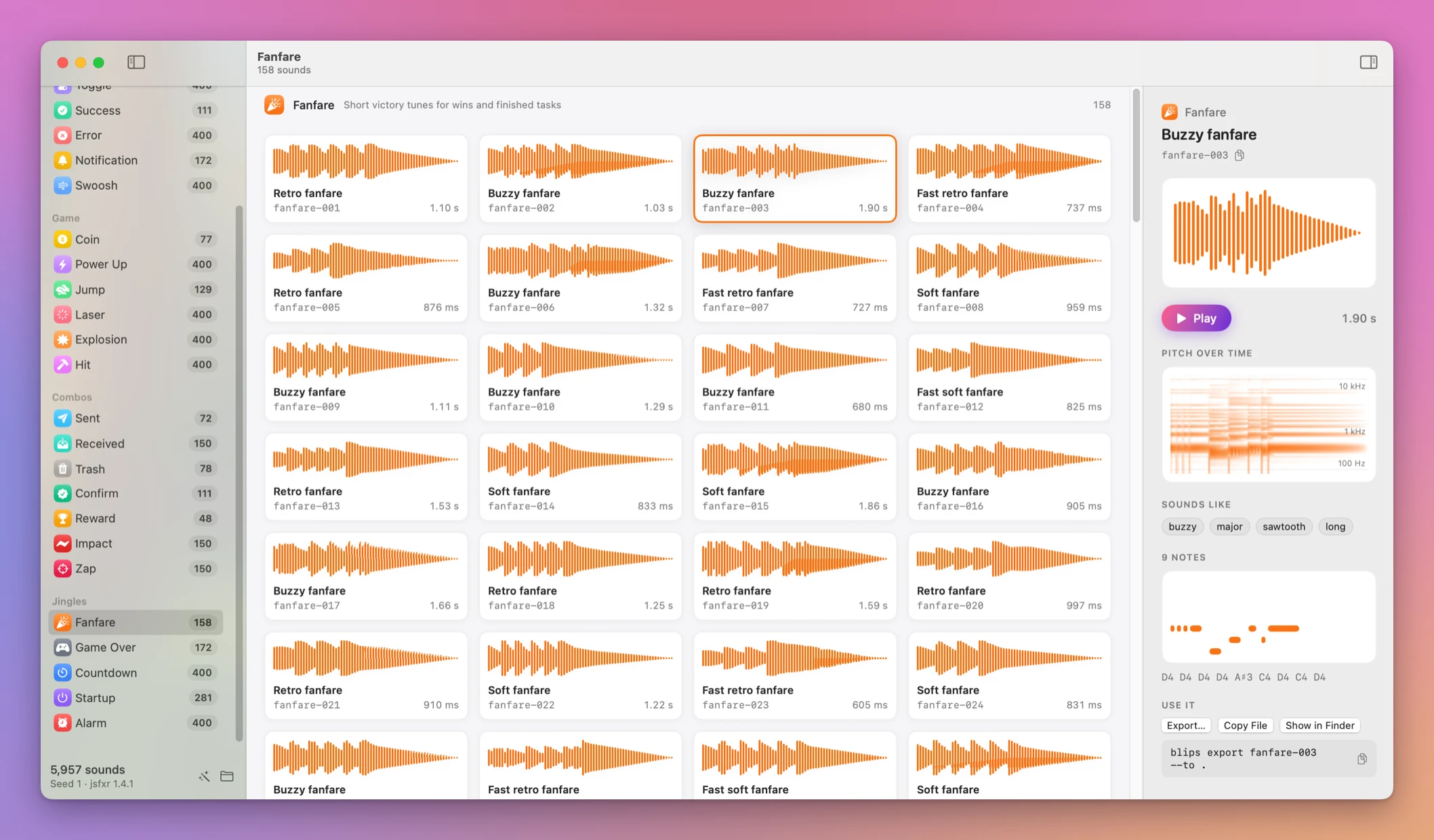
- Jingles, short tunes on a real scale: fanfare, game over, countdown, startup and alarm.
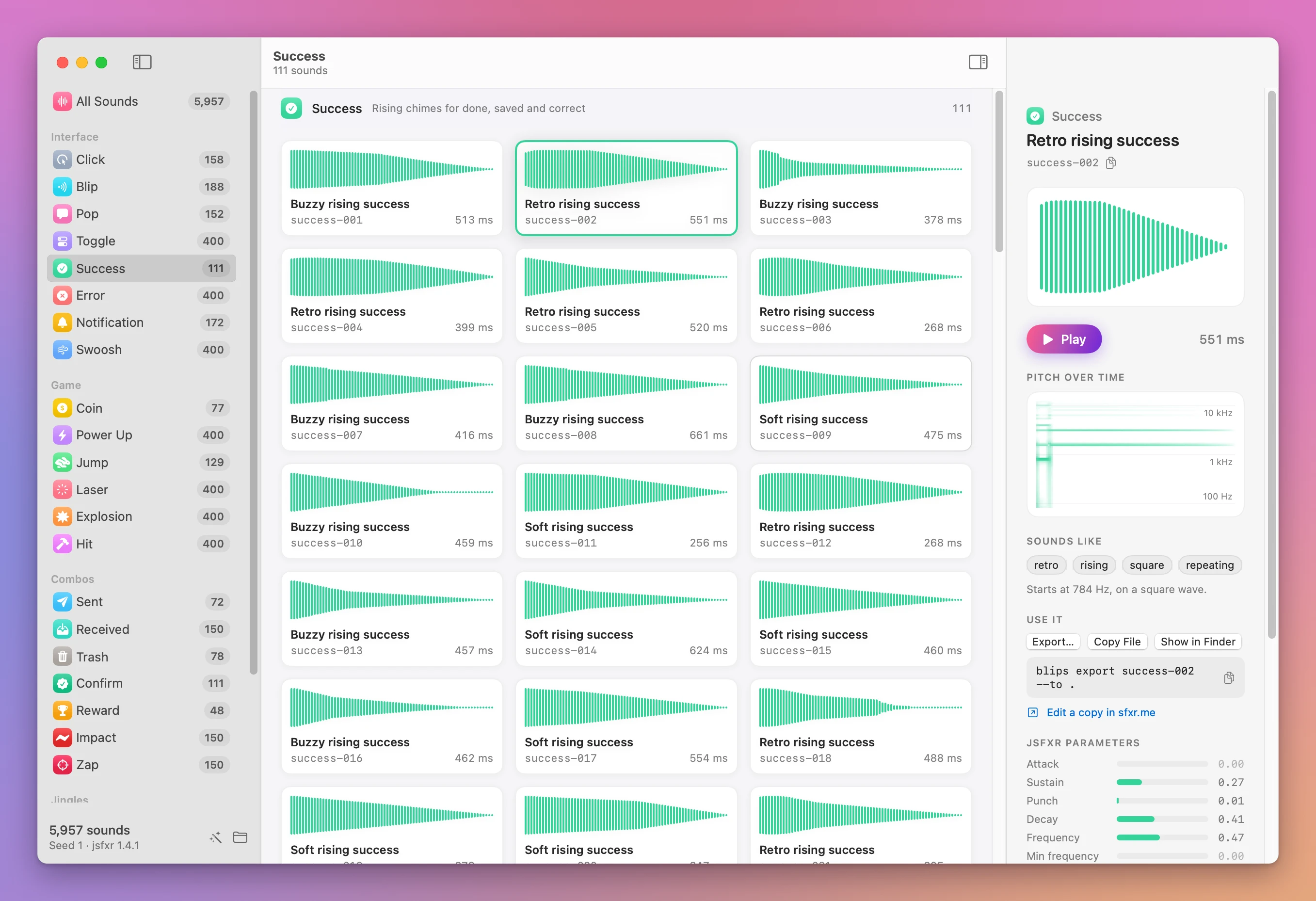
The inspector shows the selected sound’s waveform and its pitch over time, which is what tells 8-bit sounds apart: you see the jump of an arpeggio, a slide, the notes of a jingle. It also shows tags like soft, retro or rising. Below them are the jsfxr parameters, drawn like the sliders in jsfxr’s editor, and a link that opens the sound in sfxr.me if you want to tweak it.
For a combo, the inspector shows the two sounds it’s made of, and when each one starts. Click each one to hear it alone. For a jingle, it shows the notes.
Getting sounds out
- Drag a sound into the Finder or Xcode, press ⌘C to copy the file, or ⌘E to save it with another name.
- Right-click a sound to copy its ID or the
blipscommand that exports it, show it in the Finder, or open it in sfxr.me. - Right-click a category in the sidebar to export all its sounds into a folder.
Each sound is mastered to the same loudness and saved as a 16-bit WAV file, so it works in a Mac app, an iOS app, or a web page with the HTML audio tag. Your click won’t be twice as loud as your chime.
No two sounds alike
My first version made 10,000 sounds, and too many of them sounded the same. Random sounds repeat themselves: roll a success chime a few hundred times and you get the same chime a whole tone up, then again with a slightly longer tail.
So Chip Pops measures how different two sounds are. It takes a fingerprint of every sound (its pitch over time, its loudness over time, how tonal or noisy it is, and its length) and keeps a new sound only when it’s far enough from every sound already in its category. A category ends when it runs out of new sounds. That’s why there are 77 coins but 400 explosions, and about 6,000 sounds in all instead of 10,000.
Want a whole different set? Library → Generate… has New Sounds, which picks a random seed, and Seed… to get back to one you noted down.
Letting agents pick sounds
Chip Pops comes with a blips command and an agent skill, both installed from the Chip Pops menu, so Claude Code, Cursor or Codex can add sounds to an app. Ask for a sound when a note is saved, and the agent runs:
blips list --category success --tag soft --json
blips play success-003 success-005
blips export success-003 --to Resources/Sounds --name saved.wav
The agent can’t hear, so it plays a few with blips play, which uses the built-in afplay command, and asks you which one you like. Then it copies the file in, named after what it does in the app, and the skill tells it to write down which Chip Pops sound it came from. --format m4a converts the export if your project wants M4A.
That note works because every sound comes from a seed. success-003 is the same sound on every Mac, so you can always find it again, or swap it for its neighbor.
Why not download a free sound pack
Free packs and sites are fine when you need one specific sound and you find it on the first page. Don’t buy an app for one click sound.
For an app or a game that needs eight or ten sounds, packs get slow. Each pack has its own style, so your coin and your jump come from different worlds. File names don’t tell you what you’ll hear, so you open them one by one. Licenses differ from pack to pack, and some ask for credit.
| Free packs and sites | Chip Pops | |
|---|---|---|
| Hearing 100 candidates | Download, unzip, open each file | Arrow keys, one category |
| A consistent style | Mix of packs and authors | One generator, same loudness |
| Near-duplicates | Common | Filtered out by fingerprint |
| License | Varies, sometimes credit needed | Use anywhere, no credit |
| Finding the same sound later | Hope you kept the file | Same ID on every Mac |
| Coding agents | Can’t browse a website for you | blips list, play, export |
What it doesn’t do
- It only makes 8-bit sounds. No recorded foley, voices, ambiences or music tracks. If your app needs a realistic door slam, this isn’t it.
- It doesn’t have a search field in the app. You browse the categories. The
blips list --searchcommand searches from the terminal. - It doesn’t edit sounds. To change one, open it in sfxr.me in your browser.
- It doesn’t ship audio in the download. You click Generate the Library once, and the sounds are made on your Mac.
How it works
jsfxr is JavaScript, and I didn’t want a Mac app that needs Node. So Chip Pops runs jsfxr inside JavaScriptCore, the JavaScript engine built into macOS. Before every call it replaces Math.random with a seeded generator, so the same seed always rolls the same sound and renders the same noise.
JavaScriptCore runs your code in its interpreter unless the app is allowed to JIT, which surprised me: without that entitlement, 10,000 sounds took 43 seconds to generate instead of 6.
The system’s math functions, like pow, can round differently in the last digit on Intel and Apple silicon. That’s enough to flip one keep-or-reject decision and change the rest of a category, so everything the generator computes uses plain arithmetic, with its own sin, cos, log2 and exp2. The library now comes out byte for byte the same on both.
Questions
Can I use the sounds in a commercial app or game?
Yes. The sounds are yours to use in anything you make, free or commercial, with no credit needed.
Does anything get uploaded?
No. The sounds are made and kept on your Mac, in ~/Library/Application Support/Blips. The app checks for updates once a day, and opens sfxr.me in your browser only when you ask it to. There are no accounts.
How much space does it take?
About 300 MB once the library is generated.
Is the source code included?
Yes. The purchase page delivers a source ZIP with the app.
Does it work on Intel Macs?
Yes. It runs on macOS 14 Sonoma or later, on Apple silicon and Intel, and makes the same library on both.
The tutorials show it in real projects: exporting sound effects, UI sounds for a Mac or iOS app, a matching set of 8-bit game sounds, and letting a coding agent add sound effects.
Buy Chip Pops and get started
Chip Pops costs $20 including tax, paid once. The purchase includes the signed Mac app and automatic updates.
After purchase, download the signed and notarized Mac app ZIP from your purchase page.
Chip Pops checks for updates once a day. Choose Chip Pops → Check for Updates… to check now and Install and Relaunch to install.
Unzip the app, and drag Chip Pops to your Applications folder. It runs on macOS 14 Sonoma or later, on Apple silicon and Intel Macs. It’s signed with my Apple Developer ID and notarized by Apple, so it opens like any other app you download.
The first time you open it, click Generate the Library. Chip Pops makes every sound on your Mac in less than half a minute, and they take about 300 MB. The docs cover features, shortcuts and commands.